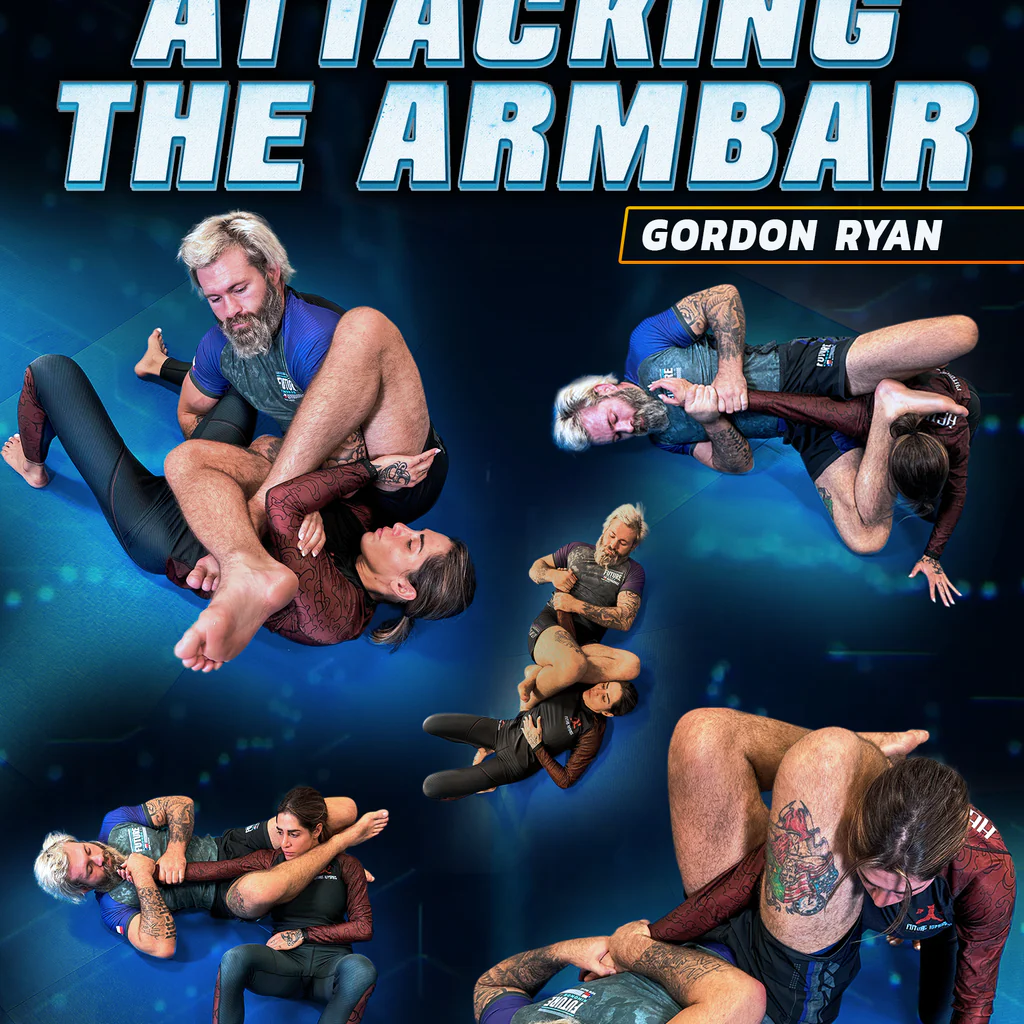
Systematically Attacking The Arm Bar By Gordon Ryan: My Full Review

A deep review of Gordon Ryan’s arm bar finishing system – 8 leg configurations, exhaustive grip breaks, and the first instructional dedicated entirely to armbar finishing mechanics.

Last updated: March 2026

Systematically Attacking the Arm Bar by Gordon Ryan

The first instructional dedicated entirely to arm bar finishing mechanics. 8 leg configurations, exhaustive grip breaks, and a tree-like decision system for every escape counter.

  • ⏰ 7+ hours
  • 📅 Released September 2023
  • 🎯 Gordon Ryan
  • 🥋 No-gi
  • 🏆 8 volumes (6 technical + 2 rolling/commentary)
My verdict: Buy this if you want to make the arm bar your primary weapon. Gordon shares finishing details that don’t exist anywhere else – the shoulder sankaku material alone is worth the price. Best used as a reference manual rather than watched front-to-back.
Check Price on BJJ Fanatics

Product Details

Full TitleSystematically Attacking the Arm Bar
InstructorGordon Ryan
Runtime7+ hours across 8 volumes
Volumes8 (6 technical volumes + 2 rolling/commentary volumes)
Release DateSeptember 23, 2023
Price$197 retail (frequently 40-50% off during BJJ Fanatics sales)
FormatNo-gi, digital/streaming via BJJ Fanatics App
Where to BuyBJJ Fanatics

What This Instructional Is About

This instructional focuses exclusively on finishing the arm bar, not entering it. Every demonstration starts with Gordon already in the spider web (arm bar control position). He identifies 8 alternative leg configurations as the backbone of the system: Quarter Juji, Lat Juji, Full Juji, Three Quarter Juji, Pillow Juji, Scissor Juji, and two Shoulder Sankaku variations (top and bottom).

Within each leg configuration, Gordon covers the same decision tree: stabilization against escapes, grip strategies for wrist control, methods for separating defensive grips, and finishing mechanics. This tree-like structure makes the instructional work best as a reference manual. Find the specific leg configuration your opponent forces you into, study the grip breaks for that position, and drill those sequences.

The approach is unique. Most arm bar instructionals cover entries from various positions (mount, guard, back). Gordon skips all of that and assumes you can already get to spider web. Once there, this is the most detailed guide available on how to actually finish the submission against a resisting opponent.

Volume-by-Volume Breakdown

Volume 1: Introduction and Fundamentals

Sets up the entire system. Gordon covers the distinction between top Juji and bottom Juji, explains the different grip types and when to use each, and maps out the escape directions opponents attempt. The key framework here is the 8 leg configurations that organize every subsequent volume. If you skip this volume, the rest of the instructional won’t make sense.

Volume 2: Quarter Juji

The first leg configuration in depth. Gordon covers stabilization from Quarter Juji, finishing mechanics specific to this position, grip breaks for when opponents lock their hands, and counters to escape attempts. Quarter Juji is often where you end up when transitioning from mount or side control arm bar attempts.

Volume 3: Lat Juji

Lat Juji techniques with a focus on countering rolling escapes. Gordon addresses the figure four grip defense (one of the most common defenses at all levels) and shows transitions between Lat Juji and other configurations when your first option gets shut down.

Volume 4: Full Juji

The classical arm bar position. Gordon covers the ways opponents escape Full Juji, stack counters for when they drive into you, and transitions to other leg configurations when Full Juji gets compromised. This is the configuration most people learn first, but Gordon shows depth here that goes far beyond the standard curriculum.

Volume 5: Three Quarter Juji

Where the system gets particularly interesting. Gordon introduces the “dilemma game” – presenting opponents with lose-lose choices where every defensive option leads to a worse position. The Three Quarter Juji grip breaks and leg entry transitions are some of the most creative sequences in the entire instructional.

Volume 6: Pillow Juji and Scissor Juji

Two variations covered in a single volume. Gordon shows stabilization techniques, finishing sequences, and omoplata transfers for when the arm bar isn’t available from these configurations. The omoplata transitions are a standout – you’ll rarely see these covered at this level of detail.

Volume 7: Shoulder Sankaku

The highlight of the entire instructional. Gordon covers Shoulder Sankaku from both top and bottom positions, escape counters specific to this configuration, and advanced sequences that combine sankaku with other leg configurations. His method of splaying the knee and the double push grip technique are standout details. This is material you won’t find taught at this depth anywhere else.

Volume 8: Live Rolling and Commentary

Live rolling demonstrations against multiple training partners with real-time commentary. Gordon explains his decision-making as he applies the system in sparring: which leg configuration he chooses and why, when he transitions between configurations, and how he reads his opponent’s defensive reactions. This volume bridges the gap between drilling and live application.

What Makes It Stand Out

  • First instructional dedicated entirely to arm bar finishing. Other arm bar instructionals (Danaher’s Enter The System: Arm Bars, Buchecha’s Arm Bar, Renato Canuto’s 50 Shades of Arm Bar) all include entries. Gordon strips everything before spider web and focuses purely on finishing mechanics. Nothing else covers this depth of finish-only instruction.
  • 8 distinct leg configurations organized as a reference system. The tree-like structure means you can look up the exact leg configuration you’re stuck in and find every grip break and escape counter for that position. Most arm bar instructionals organize by entry position (mount, guard, back). Gordon organizes by leg configuration, which is more useful once you’re already in spider web.
  • Shoulder Sankaku coverage is unique. Volume 7 covers Shoulder Sankaku at a depth that doesn’t exist elsewhere. The knee splay method and double push grip technique are signature Gordon Ryan details. The sankaku variation became one of his weapons in ADCC competition.
  • Dilemma-based teaching. The Three Quarter Juji volume introduces the concept of presenting opponents with lose-lose choices. Every escape leads to another configuration where you have a finish. This is the systematic thinking Gordon learned from Danaher applied to a single submission.
  • Rolling footage with live commentary. The final two volumes show Gordon applying the system in real sparring with real-time explanation. You see how the tree-like system works in practice, not just in demonstrations.

What Reviewers Say

“Gordon shares many details that you can’t find anywhere else and this is also the first instructional on finishing mechanics of the arm bar.”

BJJMore review

“The shoulder sankaku techniques were a revelation, with Ryan’s method of splaying the knee and the double push grip technique being standout moments.”

BJJMore review

“A revolutionary instructional, the best yet on arm bars.”

BJJMore review

No dedicated BJJ World review has been published for this instructional as of March 2026. The quotes above come from the existing BJJMore review. If BJJ World publishes a review in the future, we’ll update this section with their ratings and analysis.

Strengths and Weaknesses

What’s Great

  • The only instructional that focuses exclusively on arm bar finishing mechanics
  • Tree-like decision system makes it an excellent reference manual
  • Shoulder Sankaku material (Volume 7) is unmatched in depth anywhere
  • Dilemma-based approach from Three Quarter Juji creates lose-lose traps
  • Live rolling footage with commentary bridges drilling to sparring
  • 7+ hours of focused content on a single submission

What’s Weak

  • Repetitive when watched front-to-back. The tree structure means you’ll see 9 grip breaks for one hand position, then the same 9 grip breaks for the mirror side. Best used as a reference, not linear viewing.
  • No entry instruction at all. If you can’t get to spider web, you need a separate instructional for arm bar setups. Try John Danaher’s Enter The System: Arm Bars for a system that includes entries.
  • Assumes intermediate-level arm bar knowledge. Beginners who don’t have a baseline arm bar game will get lost. Karel Pravec’s Fundamental Armbar Mechanics is a better starting point.
  • Premium price ($197 retail) for a single-submission instructional. Renato Canuto’s 50 Shades of Arm Bar covers broader finishing variety at a lower price, though without Gordon’s systematic depth.

Who Should Buy / Who Should Skip

Buy this if you…

  • Want to make the arm bar your signature submission
  • Already know how to get to spider web and need help finishing
  • Compete in no-gi and face opponents who are good at grip fighting from bottom
  • Like studying one technique in extreme depth rather than broad surveys
  • Want a reference manual you can return to for specific situations
  • Have a solid foundation in arm bars and want Gordon’s competition-level details

Skip this if you…

  • Can’t reliably get to spider web yet (learn entries first with Danaher’s Enter The System: Arm Bars)
  • Are a white belt or early blue belt still developing your arm bar game (try Karel Pravec’s Fundamental Armbar Mechanics)
  • Prefer broad submission surveys rather than deep dives on one technique
  • Primarily train gi (this system is designed for no-gi, though core principles transfer)
  • Want to learn arm bar entries from mount, guard, and back (this instructional only covers finishing)

FAQ – Systematically Attacking the Arm Bar

Is Systematically Attacking the Arm Bar good for beginners?

Not ideal. This instructional assumes you already have a working arm bar and can get to spider web position. It focuses exclusively on finishing mechanics, not entries or fundamental concepts. Beginners should start with Karel Pravec’s Fundamental Armbar Mechanics or John Danaher’s Enter The System: Arm Bars, which covers entries, control, and finishing as a complete system.

How does this compare to Danaher’s Enter The System: Arm Bars?

Danaher’s instructional covers six phases of juji gatame: entry, control, orientation, configuration, separation, and breaking. It’s a complete system from start to finish. Gordon’s instructional focuses purely on the last three phases (configuration, separation, breaking) with much more depth on each. They’re complementary – Danaher gets you to spider web, Gordon shows you how to finish from there. Gordon trained under Danaher since his teens, so this is the student’s refinement of the teacher’s system.

How long is Systematically Attacking the Arm Bar?

7+ hours across 8 volumes. The first 6 volumes cover the technical system (fundamentals, then each leg configuration in depth). Volumes 7 and 8 contain live rolling footage with real-time commentary showing how the system works in sparring.

What are the 8 leg configurations?

The 8 configurations are: Quarter Juji, Lat Juji, Full Juji, Three Quarter Juji, Pillow Juji, Scissor Juji, Shoulder Sankaku from top, and Shoulder Sankaku from bottom. Each configuration determines your leg position relative to your opponent’s body while controlling the arm, and each has different grip break options and finishing mechanics.

Is this instructional worth the price?

At $197 retail, it’s a significant investment for a single-submission instructional. The value depends on how much you use the arm bar. If you want to make it your primary finish, nothing else covers finishing mechanics at this depth. If you only occasionally go for arm bars, the price-to-use ratio is harder to justify. BJJ Fanatics frequently runs 40-50% off sales, which brings it closer to $100 – a much easier investment to recommend.

Does this work for gi training?

The core finishing mechanics transfer to gi, but the instructional is designed and demonstrated in no-gi. Grip fighting details assume skin-on-skin contact, so you’ll need to adapt the grip break techniques for gi grips (sleeve, lapel). The leg configurations and overall system logic apply regardless of attire.

Should I watch this front-to-back or use it as a reference?

Use it as a reference. The tree-like structure means watching it linearly involves seeing the same grip breaks repeated for mirror-side variations, which gets repetitive. A better approach: watch Volume 1 for the framework, then jump to the specific leg configuration that matches where you most often stall during arm bar attempts. Study that volume, drill it, and move to the next configuration as needed.

Ready to Master the Arm Bar Finish?

Gordon Ryan’s system covers 8 leg configurations with exhaustive grip breaks and escape counters. 7+ hours of focused finishing mechanics.

Check Price on BJJ Fanatics

50% off Craig Jones, John Danaher and many other instructors!

Close the CTA

You can save 50% on instructionals -

don't miss out on today's deals

Pssst....

Craig Jones best instructionals roundup