
Do you get caught in the guillotine choke a lot? Don’t worry, Craig Jones got you covered. I just finished watching his new instructional: Mexican ground karate escapes volume 1: front headlock escapes. And I’ll tell you how to escape a guillotine choke according to Craig Jones here.
How to escape a basic guillotine
The most basic escape to a guillotine is to throw your arm over your opponent’s shoulder (of the non-strangling arm).
BUT…
That only works against a very basic guillotine. It doesn’t work against a high elbow guillotine, and also not against an arm in guillotine.
How to escape a guillotine on a high level
To escape an arm in guillotine or high elbow guillotine from a good person, follow these principles:
- Pummel your head to the other side. Often you have to push with your hand or your bicep against the strangling arm so that it crosses the centerline. This head pummel is the basic movement that you need to escape any guillotine.
- Keep your hips square. If you allow your opponent to hip escape and get to a side angle, the head pummel is difficult and the strangle is stronger. So you should block your opponent’s hips.
- Keep your opponent’s hips away. Whenever you can you should keep your opponent’s hips far away from you by posting on them with your hands. Your opponents needs his hips close to finish, so you buy yourself time. And you often create space to do a head pummel (principle #1).
- If all else fails, roll to bottom. Guillotines are harder to finish on top, because if you’re on top your hips are always square (principle #2). Moreover, if you roll to your back and push away on your opponent’s hips so he can’t follow you, you create a lot of space to do a head pummel (principle #1).
Also read: How to finish an arm in guillotine like Craig Jones
How to escape a guillotine choke from different positions
Let me repeat the principles I just explained and focus on how to apply them in different positions:
- If you’re in turtle or standing: push their elbow past you and pummel your head to the inside of their body. This is called a sucker drag. It’s the easiest way to clear a guillotine.
- If you’re in closed guard (this is the hardest position to escape from): prevent your opponent from getting his hips out by blocking the hip with your arm. Use your bicep of other arm to push the strangling grip to the inside, and pummer your head to the inside again to clear the grip.
- If you’re in some form of half guard (shin across the belly also counts): post on the hips and start to rotate to your back. Ideally you keep your back on your opponent’s chest, strip his grips and move back to side control. If you fall with your back to the floor, just keep posting on the hips, so your opponent can’t finish the guillotine. You lose top position but you don’t get choked.
- If your’re in bottom mount: post on the hips and do a kipping escape. Your priority is not to hand fight, it’s to keep the hips away. If the hips are away, there’s no finish.
Also read: Mexican ground karate escapes review: 1 big surprise!
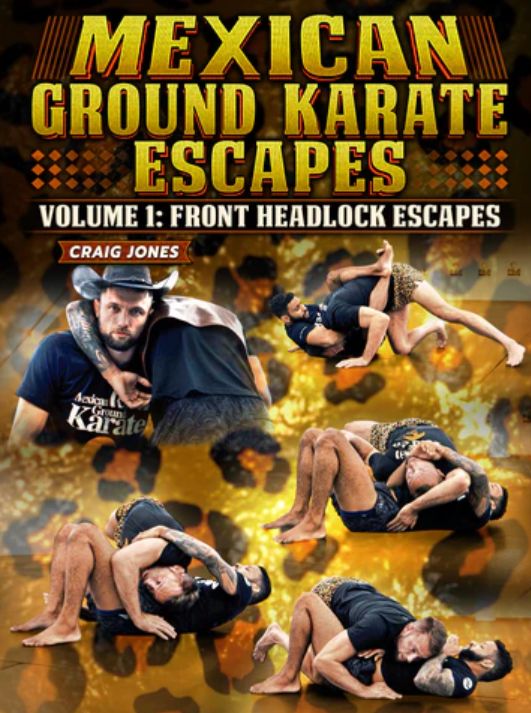
Escape guillotines, d’arces and anacondas super easily
Escape like Craig
Álso read: Top 10 Best Craig Jones Instructionals (& 6 to Avoid)
