
White belt can be the hardest belt in BJJ if you don’t know what techniques to focus on. So here’s a cheat sheet for moves and techniques that every bjj white belt should know.
Every BJJ white belt should learn at least all these moves in their white belt curriculum.
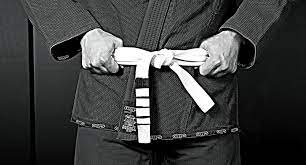
What is a ‘white belt move’ in BJJ?
Let me first address some controversy:
Some moves in BJJ are called ‘white belt moves’ in a derogatory way.
With this, people usually mean moves that only work at the white belt level.
And those moves exist.
For example, trying to break someone’s closed guard by just grinding your elbow into their thigh, will only work on white belts.
Those techniques are not really worth learning because they’ll be useless as you advance in the ranks.
However, there are also techniques that are easy to do at white belt, and that are still useful later.
For example, you will almost never finish a higher belt with an americana.
But, you can threaten the americana to make them expose their back. Higher belts do that all the time, so the americana is still useful later on in jiu jitsu.
In this post I’ll only include ‘white belt moves’ that are still useful for higher belts in some way.
What makes a technique good for a BJJ white belt?
There are two categories of techniques that BJJ white belts should learn:
Easy techniques for BJJ white belts, such as the americana and kimura (again, only if they’re still useful at higher levels as well).
Important techniques for BJJ white belts such as the triangle choke, the knee slide pass, and mount escapes.
The easy techniques are good for BJJ white belts because they can immediately use them in sparring, which is very rewarding.
But, the important techniques are not always immediately useful for BJJ white belts. But, white belts need to start practicing them anyway, because they’re too important to neglect.
So think of the easy techniques for BJJ white belts as the low hanging fruit, and think of practicing the important techniques as planting the seeds for having a rich and powerful BJJ game later on.
Also read: Top 5 Best BJJ Instructionals for Beginners & White Belts
Who is the best instructor in BJJ?

VS.

Read our reviews and decide for yourself!
BJJ white belt submissions
The most important submissions to learn as a BJJ white belt are:
- The armbar
- The rear naked choke
- The triangle choke
- The kimura
- The americana
These submissions are important for white belts to learn because:
- The armbar, triangle and rear naked choke are among the highest percentage submissions in jiu jitsu and MMA
- The americana and kimura are the easiest submissions to learn for BJJ white belts
A BJJ white belt should be able to finish the rear naked choke and the americana if you get into the position.
You may find the armbar, triangle and kimura hard to finish against colored belts, and that’s ok.
You should expect to only get the americana against other white belts, as it’s quite easy to defend once you learn it.
BJJ white belt chokes
The two essential chokes for BJJ white belts are:
- The rear naked choke
- The triangle choke.
If you want to learn even more chokes you can add some gi chokes such as the bow and arrow choke and the Ezekiel choke.
Or, if you train no gi, you can learn the guillotine choke as a basic white belt technique.
There are plenty more chokes to learn in Brazilian jiu-jitsu (such as head and arm chokes and more gi chokes) but you can reserve these for when you become more advanced.
BJJ white belt escapes
As a white belt in Brazilian jiu-jitsu you should learn to escape the major pins:
- Mount
- Side control
- Back mount
- North south
To escape Mount you should learn the trap and roll escape and the elbow escape.
To escape side control you need to do a basic bridge and hip escape to get your knee back in front of your opponent so you can push him away and get back to your guard.
To escape back mount you should try to get to the weak side and put your shoulders on the mat.
North-South is one of the hardest positions to escape in BJJ and as a white belt you might not get around to it 😉
BJJ white belt takedowns
As a BJJ white belt you should learn some basic takedowns:
- Double leg takedown
- Single leg takedown
- Double underhook takedown (Royce Gracie style)
- Leg trip from the back (Gracie Combatitives style)
You don’t need to be able to hit these takedowns during sparring, but you should be able to hit them against untrained opponents.
BJJ white belt sweeps
A BJJ white belt should know a few basic sweeps from closed guard:
- The scissor sweep
- The flower sweep (or pendulum sweep)
- The butterfly sweep
A white belt should also be able to sweep someone that’s leaning far too much in one direction by just bridging them over.
BJJ white belt guard pass
A white belt should know the following basic guard passes:
- Toreando pass
- Knee slide pass
- Double under pass
- Tripod pass from half guard
A white belt should not necessarily be able to hit these guard passes against coloured belts. Guard passing gets exponentially harder at the higher belts because the higher belts have far better guards.
At white belt, it’s more about building up and awareness of the options that you have when passing guard.
BJJ white belt guards
A white belt in BJJ should become proficient decent in the following guards:
- Closed guard
- Half guard
- Butterfly guard
The white belt should also be able to recognize and name the open guard positions:
- De la riva guard
- Reverse de la riva guard
- Spider guard
- Collar sleeve guard
- Single x guard
- X guard
Ideally, a white belt has also started playing one or two open guards, but a white belt doesn’t need to be good at all open guards yet.
Final thoughts on what BJJ white belts should know
In the end, BJJ is a martial art, which means that it’s up to each individual to express themselves through it.
So everyone’s BJJ game will be different, and that’s ok. Even at the white belt level.
Think of this list of fundamental white belt techniques as a cheat sheet for if you feel like you have holes in your game.
Or think of it as a white belt curriculum that you can loosely plan your training schedule around.
If you do that, you’ll learn enough basic techniques as a white belt to build your own game around as a colored belt.
