
John Danaher’s Feet to Floor series aims to revolutionize takedowns in jiu jitsu. So I watched it, and in this post I share my Feet to Floor review.
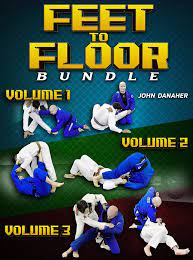
Learn all the steps you need for takedowns
Learn takedowns from scratch
Summary of my review
I really like this instructional. I highly recommend it for people who want to get started with takedowns in the gi.
What I like the most:
- The focus on foundational skills. These are the skills that make your takedowns work (such as how to create movement). This section made a big difference for my takedown game.
- All the takedowns actually work in BJJ. Instead of giving away a guillotine or your back with traditional wrestling and judo throws.
- The self defense section. This is the most interesting video I ever watched about how to use BJJ to either 1. kill somebody as quickly as humanly possible with your bare hands, or 2. put someone down super safely so you don’t get arrested. I did not buy this dvd to learn about self defense, but I will never forget this section.
What I like the least:
- John talks too long (as always). I can tolerate it for this dvd because I’m such a noob in takedowns that it’s actually good for me that he repeats gimself 5 times – but man does John annoy me sometimes.
- Too much focus on guard pulls. John is big on pulling guard directly into sweeps and submissions. I get that it’s a smart idea to attack directly after a guard pull, but I would rather just not guard pull at all. So this section was a dud for me.
All in all John Danaher teaches a very systematic approach to takedowns for BJJ, and I think it’s gonna be very useful for everybody who doesn’t have a strong takedown game yet.
Things to Consider Before Buying a BJJ Instructional
Before you read my Feet to Floor review, you should consider who the ideal customer of a BJJ instructional is.
BJJ Instructionals can be an incredible shortcut in your BJJ learning journey. You literally get to learn the best moves from the best BJJ guys in the world. And some of the instructors have become incredibly good in presenting their material in a systematic manner so that it’s much easier to adopt than the material you get taught in class.
However, BJJ instructionals are not a magic bullet for improvement in BJJ. You still need to put in the work yourself to actually learn the moves and systems they teach. And because instructionals are getting longer nowadays (and more valuable!) they are becoming more long term projects.
Therefore, I always ask myself the following questions before I buy a BJJ instructional:
- Am I interested enough in this instructional to keep working on it for at least six weeks?
- Can I set aside training time to specifically drill the techniques of this instructional?
- Do I have one or more training partners that I can practice these techniques on?
The answer to the first question is entirely under your own control.
But, the answer to the second question depends on whether your gym provides enough time for you to work on your own techniques, for example before class or during open mats.
The answer to the third question depends on your training partners: can they actually perform the responses that your techniques require, or are they willing to learn them?
For example, until recently my gym was entirely gi focused and nobody was really interested in training heel hooks, so I couldn’t practice the secondary and tertiary responses from the leg lock dvd that I had bought.
What is Danaher’s Feet to Floor Instructional Series?
Feet to floor is the most comprehensive instructional about takedowns for BJJ to date. Before Feet to Floor came out, you had only a few very small dvds on BJJ takedowns, or you had to watch judo or wrestling instructionals, which don’t necessarily translate well into BJJ.
Danaher has adapted every technique and takedown he shows to BJJ specifically. And he covers the standing position fully, including stance, grip fighting, takedowns, guard pulls and flying submissions.

This instructional is perfect for BJJ athletes that normally neglect the standing position (AHEM – all of us) and want a comprehensive overview of it to start learning takedowns seriously.
Oh and if you’re new here, you might be wondering who John Danaher is. John Danaher is a Renzo Gracie black belt in Brazilian jiu jitsu and arguably the greatest grappling coach ever. He is best known for revolutionizing our martial art with his leg lock system, but he has many other instructional videos, about the headlock, closed guard, half guard, open guard, escapes and gi fundamentals. And now he has this instructional on takedowns and the standing position.
Is It Good? My Danaher Feet to Floor Review (Volume 1, 2 & 3)
For my Feet to Floor review I’ll break review each volume separately, as well as each topic within each volume.
Feet to Floor Review: Volume 1
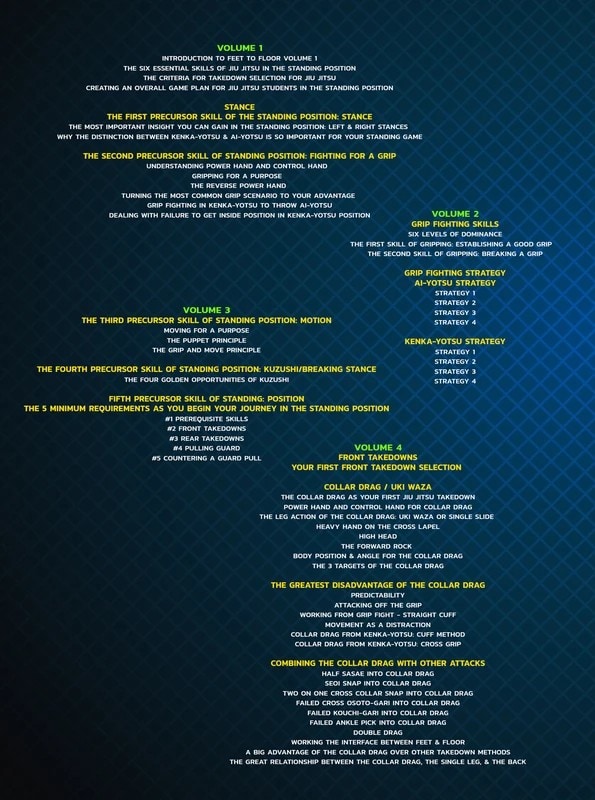
Feet to Floor 1 aims to have you score takedowns within 3 to 6 months against opponents of your own size and skill level.
To achieve this, this dvd focuses on takedown selection criteria, precursor skills and a set of simple takedowns.
Takedown Selection Criteria for BJJ
Danaher shares his criteria for selecting takedowns that work well in BJJ. If you’re interested in this, you can also watch a long Youtube video in which he explains this completely. His selection criteria are: back exposure, weight exposure, neck exposure, roll through potential, belt exposure, and difficulty.
Precursor Skills – Stance, Posture, and Grip Fighting
Danaher instructs the precursor skills of takedowns very well, which I value highly because I think they’re actually more important than the takedowns themselves.
He shares a grip fighting strategy, including a hierarchy of different grips, that is commonly used in judo (but adapted for BJJ by including grips that are penalized in judo such as the cross collar grip).
I was already using this strategy after watching tons of judo videos on Youtube, but I think this will be very helpful to those with less experience in the standing position.
The Takedowns
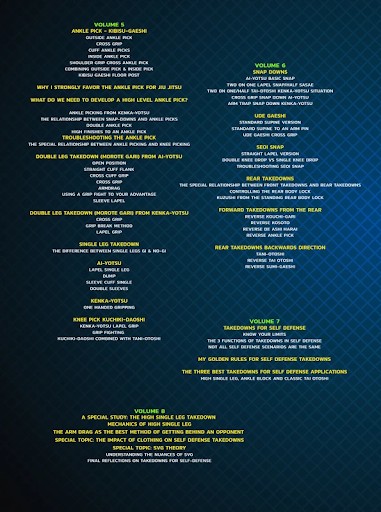
The takedowns that are discussed in Volume 1 are the collar drag, ankle pick and snap downs. These are selected because they’re easy to perform.
Danaher’s technical instruction of the takedowns themselves is good. As usual, he repeats himself quite a lot, but there’s no way you walk away from his instruction without remembering the most important details!
For myself, I’ve had more success with ankle picks than I expected I would, which is great 🙂
Bonus: Takedowns for Self Defense
Danaher also includes a bonus section on takedowns for self defence (and it’s really a discussion of the value of BJJ for self defence more generally).
This section completely blew me away. I expected a general ‘try not to get punched by staying close to your opponent’ advice, but Danaher gave much more value than that.
I won’t be able to summarise everything here, but I’ll share some of my actionable takeaways:
- Untrained people are much better at falling forward than falling backward, so in low intensity fights you should always throw them forwards to protect them (and to protect yourself from legal consequences)
- Body lock takedowns are impossible against people that are very fat or very tall – single leg takedowns work against everyone
- In chaotic fighting situations, takedowns are still very useful. You can pick up a single leg and throw someone down moderately hard for intimidation, or extremely hard for damage.
- In chaotic life or death situations, you may have to resort to throwing people to the ground and then kicking them while they’re down. This is the quickest and possibly the safest way to inflict massive damage on people.
This bonus section was not at all why I bought this dvd, but it’s by far the part that I enjoyed the most. It makes me feel like BJJ is actually very well suited for self defence situations of any intensity (including against multiple opponents) :D. .
Feet to Floor Review: Volume 2
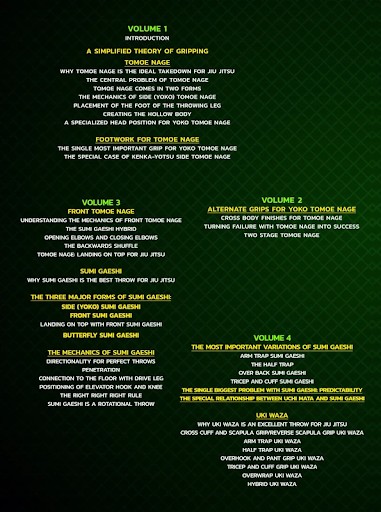
Feet to Floor Volume 2 covers the 3 big sacrifice throws (which Danaher calls ‘the 3 kings’): tomoe nage, sumi gaeshi and uki waza. And it covers all the foot sweeps (ashi waza).
The 3 Kings: Tomoe Nage, Sumi Gaeshi and Uki Waza
Danaher selects these 3 throws because they’re relatively easy to learn, and if they fail they turn into a guard pull.
His technical instruction is very detailed. I was already working on these throws, but I still picked up some details from him.
One thing I particularly liked is that Danaher shows how to set up these sacrifice throws from disadvantageous grips. In the judo videos I watch on Youtube they always assume the standard judo grips (collar and sleeve), but Danaher shows many grips that are bad or illegal in judo, but fine for jiu jitsu and much easier to get (for example double back of the tricep grips).
Foot Sweeps (Ashi waza)
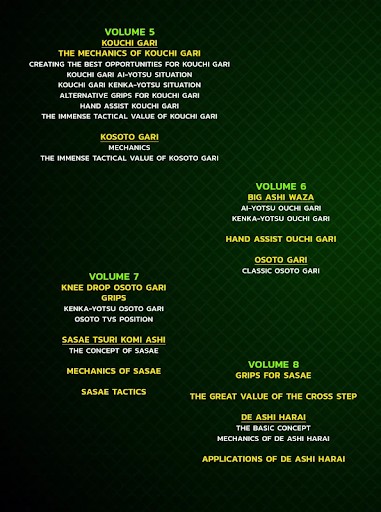
Danaher shows all the common foot sweeps because they’re among the most useful and powerful throws in grappling (but they’re hard to learn).
Before I watched this instructional I had already been working on foot sweeps for ~6 months, so as I expected, I got a little bit less out of this section. But Danaher still shared many details that I wasn’t aware of.
For example, Danaher explains that in kosoto gari (the small outer foot sweep), you need to first load your opponent’s weight onto his leg, then hook it, and then push his weight away from that leg again so that you can sweep it. This nuanced detail made my kosoto much more effective already.
Feet to Floor Review: Volume 3
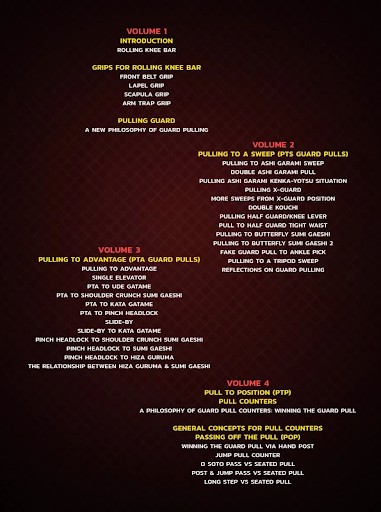
Feet to Floor Volume 3 is the most specific to BJJ. It discusses ways to attack directly after your guard pull, countering guard pulls, and takedown counters.
Pulling Guard directly into Attacks
This section is quite revolutionary to me. I already tried to pull guard right into an overhead sweep in tournaments, but I succeeded only occasionally – which is what you expect if you only know 1 move. Professor Danaher shows many more ways to pull guard right into a sweep or another advantageous position, and I don’t see why everybody doesn’t always do this. It’s just better.
I need more time to implement many of the attacks that Danaher shows, and I’m excited to work on the submissions of the pull. But one simple thing that’s working great for me already is to pull directly into a simple tripod sweep. So I start many of my rolls with an instant sweep now.
Countering the guard pull
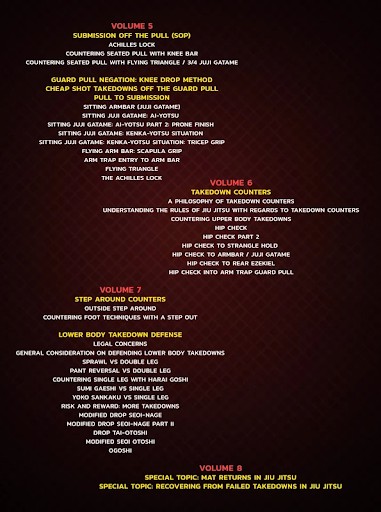
Professor Danaher explains how to counter guard pulls and this has already been very effective for me. I used to not really react instantaneously when people pulled guard on me, but now I use Danaher’s knee post method and I start passing right away.
I think that all these guard pull counters are actually quite easy so in theory you can learn them from Youtube videos too. But what made a big difference for me is that Danaher broke down the 3 different ways in which people pull guard, and how to react to each of them.
I also specifically liked that he explains that you can pull guard to the side where you have the sleeve, or the side where you have the collar, and both are correct. Many people teach that only the sleeve side is correct, but he shows there’s pros and cons to both of them.
Takedown Counters
I learned a lot from this section, possibly because I neglected learning defence and counters so far. I was aware of some counters to the single leg (guillotine, kimura, sumi gaeshi), but I didn’t know all the hip check counters to turn throws (such as countering an uchi mata or seoi nage with a hip check and an arm bar).
Feet to Floor Series Review: Summing up all the parts
I think that Danaher put together an amazing instructional series on the standing position in BJJ. I learned a lot from each of them, and I’m happy that I watched them in order. I think that over time I’ll come back to the precursor skills sections from Volume 1, the Ashi Waza sections of Volume 2 and the Pull to submission sections of Volume 2.
Is Danaher’s Feet to Floor worth it?
I learned an immense amount from the Feet to Floor series, and I was already someone who was interested in takedowns. To me, it was absolutely worth it.
It’s Danaher’s dream that within 5-10 years, BJJ as a whole will be much better at stand up than it is right now, and better than any other martial art in a BJJ rule set. And I definitely believe that if more and more people start watching the Feet to Floor series, and we collectively improve out technique, this is exactly what will happen.
I hope my Feet to Floor review was helpful to you. If you have any more questions, let me know!
Learn all the steps you need for takedowns