
So you just bought a new BJJ gi and you’re not sure it’s the right size. Maybe it’s too big or too small, or maybe it’s alright. In this article I share some example pictures of BJJ gis that don’t fit, I tell you how to know if your BJJ gi fits and I tell you what to do with a gi that doesn’t fit.
Attention: use the gi size calculator below to find your correct gi size.
GI Size Calculator
Also read: The Complete BJJ Gi Size Guide | Gi Size Calculator & 3 Gi Size Charts
How Should a BJJ gi fit?
A BJJ gi should be big enough to cover your wrists and ankles, but not much bigger (these are the official BJJ gi fit rules from the IBJJF). A gi should also be loose enough for you to move around freely, especially in the groin and hip area.
How to know if your BJJ gi fits?
You can know if your BJJ gi fits by doing the following test while wearing your gi:
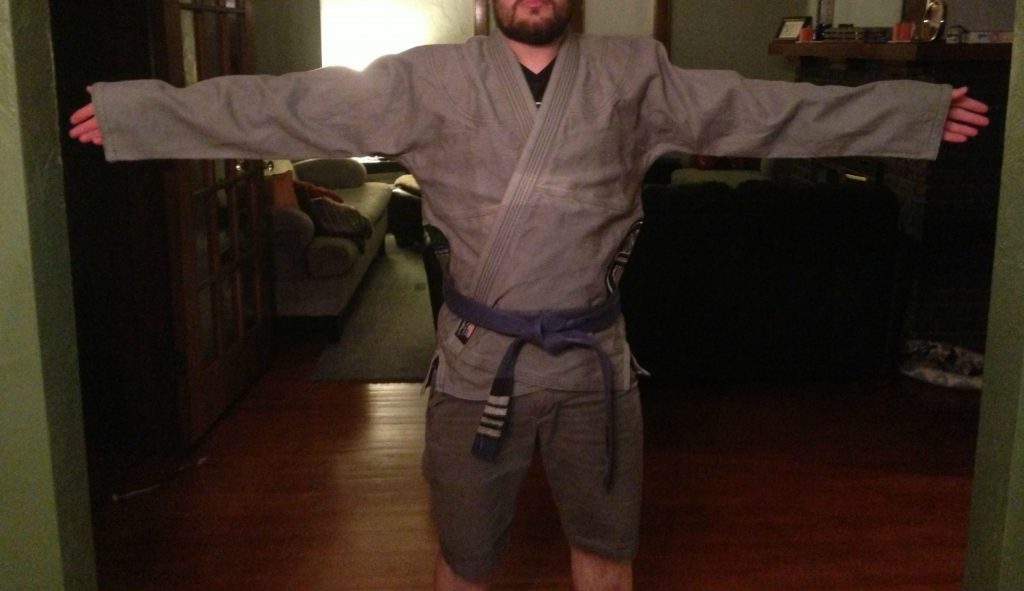
- Stretch out your arms in front of you: do the sleeves end around your wrist? Your gi fits correctly if the sleeves are within the width of 2 fingers from either side of your wrist.
- Stand up straight: do the gi pants end around your ankles? The pants legs are too long if they hit the floor, and too short if they end more than 2 fingers width above your ankles.
- Lay down on the floor, stretch one leg to the floor and raise your other knee to your chest. The gi pants are too tight if they impede your natural range of motion.
If you pass these 3 tests then your BJJ gi fits correctly.
IBJJF Gi Measurement Rules: What You Need to Know for Competition
If you compete under IBJJF rules (which covers most major BJJ tournaments), your gi needs to pass a gi check before you step on the mat. The referees will physically measure your gi, and if it fails, you don’t compete. Here are the exact rules from the IBJJF uniform requirements:
- Sleeve length: The sleeves must reach no more than 5cm (about 2 inches) above the wrist bone when you extend your arms forward. This is the measurement that catches most people, especially tall practitioners who size up for body length but end up with sleeves that ride too high
- Pants length: The pants must reach no more than 5cm above the ankle bone. Same problem for tall athletes: standard sizes are often too short
- Sleeve width: There must be a 7cm (about 3 inch) gap between the inside of the sleeve and the arm at any point along the forearm. This prevents people from wearing skin-tight gis to avoid grips
- Pants width: Same 7cm gap rule applies to the pants along the lower leg
- Collar thickness: The collar must be no thicker than 1.3cm at any point. Some older gi models have collars that are too thick
- Colors: Only white, royal blue, or black gis are allowed. The jacket and pants must be the same color
Pro tip for tall athletes: If you’re 6’0″ or taller, always check whether the gi you’re buying has “L” (Long) sizes like A2L or A3L. Standard sizes often fail the IBJJF sleeve and pants length checks for taller builds. We cover this in detail in our guide to gis for tall and skinny practitioners.
How to check at home: Before competition, put on your gi and stand in front of a mirror. Extend your arms straight forward and check where the sleeves hit your wrists. Then stand normally and check where the pants hit your ankles. If either is more than two fingers above the wrist/ankle bone, you might fail the gi check. Use our interactive gi size calculator to find the right size before you buy.
What to do when your BJJ gi doesn’t fit?
If your BJJ gi doesn’t fit, you can solve that problem in a few different ways. The solution you need depends on whether your gi is too big, too small, too baggy or too tight.
| Problem \ Solution | Return it | Sell it | Shrink it | Tailor it |
| Too big | Yes | Yes | Yes | Yes |
| Too long | Yes | Yes | No | Yes |
| Too loose | Yes | Yes | No | No |
| Too small | Yes | Yes | No | No |
| Too tight | Yes | Yes | No | No |
Also read: Best BJJ Gi Brands: Complete Guide
BJJ gi too big
Is your BJJ gi too big all around? There’s a few ways to fix up an oversized gi:
- Return it and buy a new gi. This is always the easiest option if your gi doesn’t fit, as most stores have free return policies. And use my gi size guide this time to get the sizing right.
- Shrink it in the wash or dryer. This works very well if your gi is a few inches too big all around. You can expect to shrink about 10% off your gi. (Also read: how to shrink you BJJ gi.)
- Take your gi to the tailor. This works especially well if your gi is too long. I took several gi’s to the tailor when the gi pants were too long, and they were able to hem the gi pants cheaply and quickly.
BJJ gi too small
Is your BJJ gi too small? Unfortunately you can’t make it bigger. But here’s what you can do:
- Return it and buy a new gi. Use my gi size calculator this time, so you can get the sizing right.
- Sell it to someone at your gym. This happens a lot in BJJ gyms. Just try to see who’s smaller than you and ask if they’re interested in buying a new gi from you because you bought the wrong size.
BJJ gi too loose or baggy
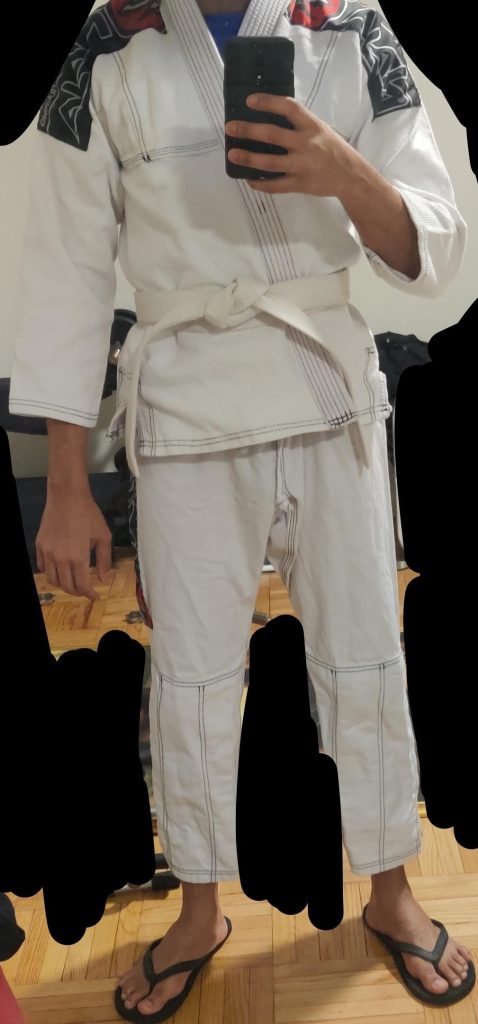
Is your BJJ gi too baggy or loose, but not too long? In that case I don’t recommend shrinking it (because it will become too short), and it’s hard for the tailor to help you.
But, a gi that’s too loose is also not a super big problem. You can just suck it up and train in it, or you can try to sell it to somebody at your gym.
BJJ gi too tight
Is your BJJ gi too tight? Then the question is where it’s too tight. If the jacket is too tight, that’s usually not a big problem. (It’s actually an advantage because it makes it harder to grip you).
If the pants are too tight around the groin area and they impede your movement, that’s a big problem. It’s also impossible to make your gi more loose, so you’ll have to return this gi or sell it.
Is it better to have a BJJ gi too big or too small?
It’s better to have a BJJ gi that’s a bit too big than to have one that’s too small. The reason is that a gi will always shrink a little bit over time in the wash. And a big gi also doesn’t inhibit your movement, so it’s not as big of a problem as a gi that’s too small.
Is it better to have a BJJ gi too tight or too loose?
It’s better to have a gi that’s too loose than to have a gi that’s too tight, because a tight gi inhibits your movement. However, if you gi is only a little bit too tight and doesn’t inhibit your movement, that’s actually fine. As a matter of fact, it’s an advantage because it makes you harder to grip, and you should consider using this gi as your competition gi.
Also read: The best lightweight BJJ gi for competition
BJJ Gi vs Judo Gi vs Karate Gi: Can You Swap Them?
One of the most common questions from beginners who cross-train: can I just wear my karate or judo gi to BJJ class? Short answer: no for karate, technically yes but not ideal for judo. Here’s why.
Karate Gi vs BJJ Gi
A karate gi and a BJJ gi are built for completely different purposes. Karate is a striking art, so karate gis are thin and loose to allow quick movement and high kicks. BJJ is a grappling art where your opponent constantly grabs your collar, sleeves and pants. A BJJ gi needs to survive that abuse.
The key differences:
- Thickness: A BJJ gi jacket is 2-3x thicker than a karate gi, typically using pearl weave (450gsm+) vs the lightweight cotton of a karate gi
- Collar: BJJ gis have a reinforced rubber-core collar that can withstand cross-collar chokes. A karate gi collar is thin and cuts into your neck when grabbed
- Sleeves: BJJ gi sleeves are fitted and have minimum length requirements for competition. Karate gi sleeves are wide and short to make a snapping sound on punches
- Reinforcement: BJJ gis have extra stitching at the knees, armpits and lapel areas that take the most stress during grappling
- Price: A karate gi costs $20-40, a BJJ gi costs $50-200+ because of the heavier materials and construction
Bottom line: Don’t wear a karate gi to BJJ. It will rip within a few sessions (usually at the knees or armpits first), the collar will dig into your neck during chokes, and most instructors won’t allow it. If budget is a concern, a Sanabul Essentials costs under $50 and will actually survive training.
Judo Gi vs BJJ Gi
Judo and BJJ gis are much closer relatives since both are grappling arts. You can wear a judo gi to BJJ class, but there are real disadvantages:
- Sleeves and lapels are much wider on judo gis (intentionally, to promote offensive judo throws). In BJJ this means your opponents can grip you more easily, which is a significant handicap
- The skirt (bottom of the jacket) is longer on judo gis, which covers your thighs but can get in the way during guard work
- Judo gi pants are thinner at the knees because pant grips are illegal in judo competition. In BJJ, your partners will grab your pants constantly and the knees will wear through fast
- The jacket comes loose more easily because judo allows breaks to re-tie your gi, while BJJ rolls are continuous
Bottom line: A judo gi works in a pinch (especially for your first class), but get a real BJJ gi once you know you’re sticking with it. And if you’re a judoka adding BJJ, your judo gi’s wider sleeves are giving your training partners an unfair advantage on grip fighting.
For kids who are just trying out BJJ, borrowing a judo gi from the academy is perfectly fine. Most instructors won’t mind for the first few weeks. See our complete gi buying guide for more recommendations.
How Different Brands Fit: Quick Reference
Not all A2s are created equal. Here’s how popular gi brands actually fit, based on community experience and our own testing:
| Brand | Fit Profile | Best For | Notes |
|---|---|---|---|
| Fuji | True to size | Standard builds | Most consistent sizing in the industry. A2L/A3L available for tall builds |
| Tatami | Slightly slim | Athletic builds | Runs a touch narrow in the shoulders. A2XL option for extra-tall (6’0″-6’4″) |
| Gold BJJ | Slim, lightweight | Athletic/lean builds | Aeroweave is 275gsm (lightest on market). Runs slim through torso |
| Scramble | Long cut | Tall/athletic builds | Naturally longer sleeves and pants without needing L-sizes |
| Inverted Gear | Slim, long | Lean/tall builds | Consistently praised for slimmer cut with good arm/leg length |
| Kingz | True to size | Standard/athletic | A2L available up to 6’3″/200lbs. Reliable IBJJF legal cuts |
| Sanabul | Runs large/baggy | Stocky/heavy builds | Budget-friendly but expect a looser fit. Size down if between sizes |
| Hayabusa | Generous cut | Stocky/muscular | Premium quality with extra room in chest/shoulders |
The takeaway: if you’ve been burned by bad sizing before, the brand matters as much as the size. A “slim” A2 from Scramble fits nothing like a “generous” A2 from Sanabul. Always check the brand’s specific size chart before ordering, or use our gi size calculator which covers 13 brands.
Recommended Gis by Fit Type
Now that you know how a gi should fit, here are some gis that are known for fitting specific body types well. These are based on years of community feedback and our own testing.
- Standard fit: Fuji All Around – The most consistent sizing across all body types. If you just want a gi that fits without surprises, start here.
- Athletic/slim fit: Gold BJJ Aeroweave – Runs slim through the torso and arms, ideal for athletic builds. Also the lightest competition gi on the market.
- Tall and skinny: Tatami Nova Absolute – Long sleeves and pants without being baggy in the chest. If you always end up between sizes, check our tall/skinny gi guide for more options.
- Stocky/heavy build: Hayabusa Lightweight – Generous cut in the chest and shoulders without being excessively long in the arms.
- Budget-friendly: Sanabul Essentials v2 – Under $50 with decent fit consistency. A good option if you want a second gi to rotate without spending a lot.
Not sure which brand fits your build? Use our interactive gi size calculator to find your exact size across 13 brands. For a complete breakdown of all major brands, check our gi brands ranking.
FAQ
Can I use a judo gi for BJJ?
You can use a judo gi for BJJ training (especially as a beginner), but it’s not ideal. Judo gis have wider sleeves and lapels that make you easier to grip, thinner knee reinforcement that wears out fast from pant grips, and a jacket that comes untucked more easily. Most BJJ instructors will allow a judo gi for your first few classes, but get a proper BJJ gi once you’re committed.
Can I use a karate gi for BJJ?
No. A karate gi is far too thin for BJJ. It will rip within a few training sessions (usually at the knees or armpits), the collar will cut into your neck during chokes, and most instructors won’t allow it. Even the thickest karate gi is still much thinner than a BJJ gi. If budget is a concern, you can get a Sanabul Essentials for under $50.
What are the IBJJF gi size requirements?
For IBJJF competition, sleeves must reach within 5cm of your wrist bone, pants must reach within 5cm of your ankle bone, there must be a 7cm gap between the sleeve/pants and your arm/leg, the collar can’t be thicker than 1.3cm, and only white, royal blue, or black gis are allowed. Tall athletes should pay special attention to sleeve and pants length requirements.
How tight should a BJJ Gi be?
A BJJ gi should be comfortably tight. It shouldn’t impede your natural range of motion, but it also shouldn’t be much looser than that.
Can you hem gi pants?
Yes you can hem gi pants. You can do it yourself or you can bring your gi pants to your local tailor, who should be able to hem your gi pants for a cheap price.
Can you bring your gi to a tailor for alterations?
Yes a tailor can easily alter your gi. Depending on what you need done this can be very cheap (for some simple hemming) or expensive (if you need many different alterations).
How much does a BJJ gi shrink after washing?
Most 100% cotton gis will shrink about 5-10%, which translates to roughly 1-3 inches in length depending on how you wash them. Want to keep the original fit? Stick to cold water and hang dry. If your gi runs a bit big, you can actually use this shrinkage to your advantage—a warm wash and low-heat dryer cycle will bring it down to size. Just remember, once you shrink it, there’s no going back.
What’s the difference between A2 and A2L?
That “L” stands for “Long” or “Lean”—it’s for taller, thinner people who find regular A2 too short in the arms and legs but A3 too baggy everywhere else. A2L gives you A2 body width with longer sleeves and pants. You’ll also see “H” for Heavy/Husky (wider cut) and “S” for Short. Every brand does these differently, so always check their specific size chart.
Is it better for a gi to be slightly big or slightly small?
Always go bigger if you’re between sizes. You can shrink a gi down, but you can’t stretch it out—that’s the golden rule. A gi that starts too small will only get tighter with each wash, restricting your movement and potentially making it illegal for competition. When you size up, you get control over the final fit through how you wash and dry it.
Can you tailor a BJJ gi?
Absolutely. Shortening sleeves and pants is pretty standard. The key is to wash and dry your gi at least once before you take it to a tailor—you need to account for that initial shrinkage first. Find someone who works with heavy fabrics like denim, and if you compete, make sure they know IBJJF length requirements so you don’t end up with illegal measurements.
