
Home / Best triangle instructionals / Triangles: Enter The System Review
Triangles: Enter The System (Danaher): Worth It?
Buy it if your triangles get stuck half-locked. Danaher’s fix: turn until your opponent’s shoulder is out of the triangle, so even short legs have less to wrap around. Skip it if you want a short course.
See Triangles: Enter The System →Danaher or Craig? Which one for you ↓
- No-gi
- 8 volumes, 8 h 43
- 91 chapters
- Five triangles
- No live rounds
- Released January 2019
It shows why your triangle won’t lock
You get his head and one arm between your legs, and there it stalls: your feet won’t lock, you squeeze, and he sits up and is gone. “Triangles are almost never born fully grown,” Danaher says, and he builds one in stages. Where yours stalls, you turn until your opponent’s shoulder is out of the triangle. It is long, and there are no live rounds.
$197 at list, $82.74 with the house code EXTRAXX58 (tested November 11, 2026), for 8 h 43.
15 details that make a triangle finish
A triangle from guard, from the first grip to the tap, in the order Danaher builds it. Last, triangles from other places.
He won’t hold still
Nothing happens until you can keep him in front of you. Two grips and a push, all from sitting up, where Danaher starts his students.
01 Two-on-one: take the elbow first, then pin his knuckles flat to your chest
“I secure the elbow first and I draw it towards me and I hold with no thumbs.” Against your chest, he says, the hand is stuck.
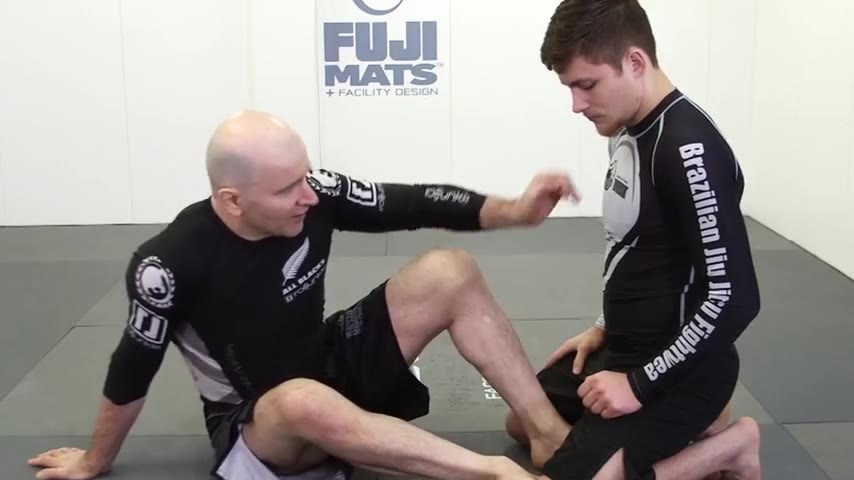
Vol 2 · 1:01:2002 Foot on his knee: push, don’t kick, and his hand goes to the mat
“It’s a push, not a kick.” Once his hand touches the mat, Danaher says, the triangle “is right in front of you”.
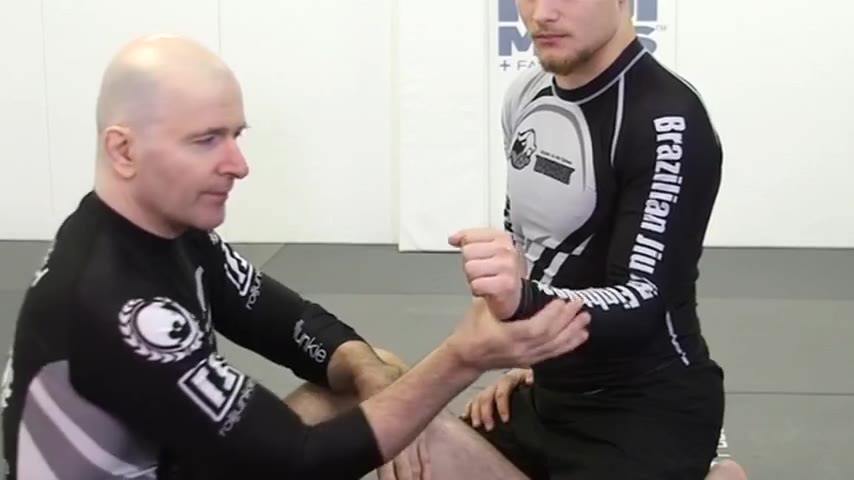
Vol 3 · 32:4303 Inside wrist grip: your own wrist bent back, your arm long
Thumb “inside my opponent’s wrist right at the veins”. Now he can’t bring that hand back to the middle, Danaher says.
Vol 3 · 24:02His arms are in the way
The grip keeps him there. Every triangle is then the same story, Danaher says: one arm inside your legs, one outside. So a leg has to get over his shoulder: a drill, his favourite way in from his back, and the counter to it.
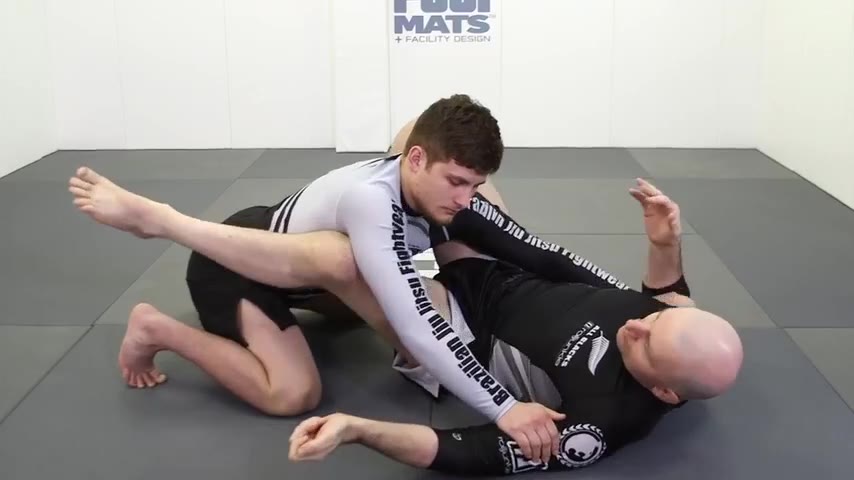
04 No hands: hips off to the side, knee pointing at the mat, then knee to chest and the leg kicks over the top
A partner drill. Knee and toes down “makes it easy for me to bring my foot through, around and lock the figure of four.”
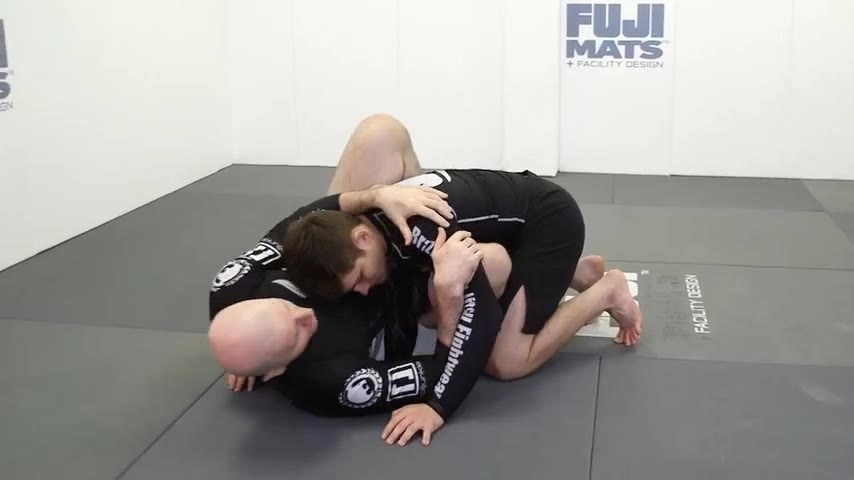
Vol 1 · 51:1405 The clamp: one knee in front of one shoulder, the other behind the opposite shoulder
His head and one arm are caught between your knees, Danaher says. He calls it “the single most commonly used method of entering the triangles” for him and his students (Vol 3, 48:07).
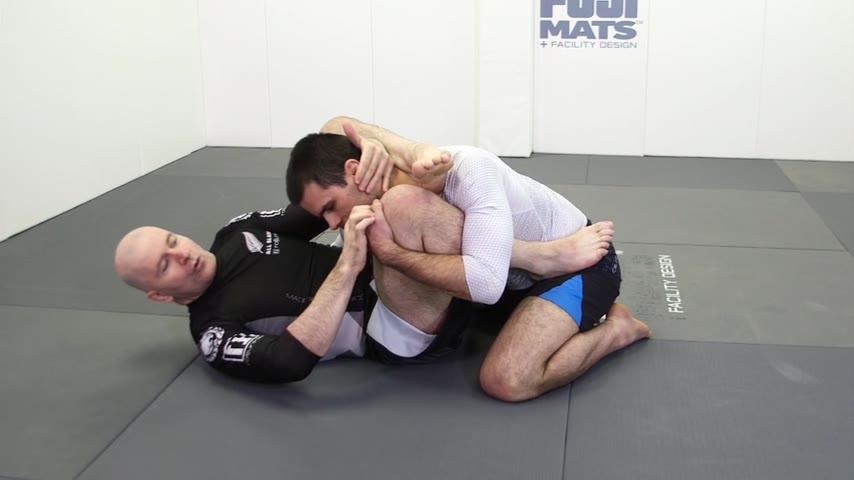
Vol 3 · 43:2806 He grabs your leg: take all four knuckles, peel the hand off, kick your leg over
Someone who knows the clamp holds your knee. “I’m not allowed to grab one, two, or three fingers. But I am allowed to grab all four knuckles.”
Vol 3 · 1:02:54He sits up before you lock
His head and one arm are between your legs. Danaher calls it the trap triangle, and it strangles nobody yet. Your opponent’s first move is to sit up.
07 Not even locked: both lower legs point the same way, and he can’t posture out
No figure four yet. When he tries to sit up, Danaher says, the shape holds. “We always want the two lower legs pointing like arrows in the same direction.”
Vol 2 · 41:46Your legs won’t lock
He stays down, and now your foot won’t reach the back of your own knee. Danaher’s reason: too much of your opponent is inside your legs. Two fixes, in his order.
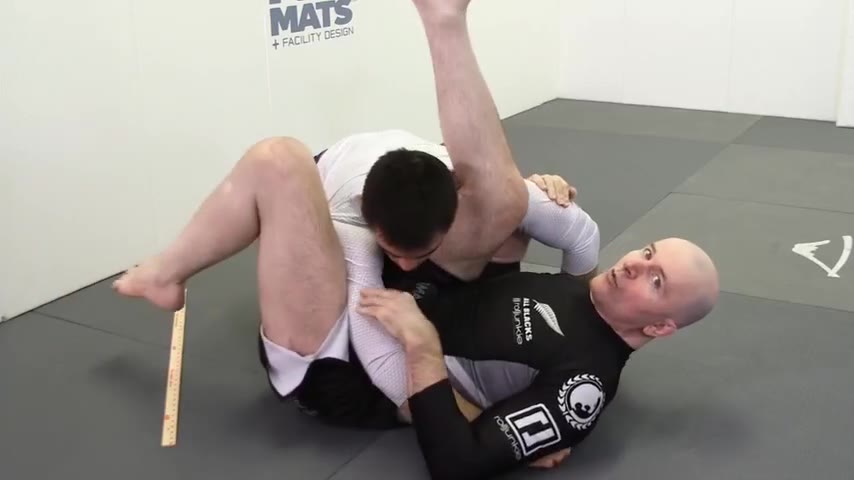
08 Stay above the shoulder line
Danaher holds a stick at the top man’s shoulders and shows the strangle leg over it versus under it. Under it you get “only half of the triangle”. He says he screams this rule as a coach.
Vol 2 · 6:4809 Turn to an angle until the shoulder disappears: your knee in front of his shoulder, only his head and one arm inside
“A good application of any front triangle will mean that from the camera’s point of view, the shoulder disappears.” Then “even short legs like mine have an easy time”.
Vol 2 · 9:25He pushes his shoulder back in
Someone who knows this puts a hand behind your hip, and his shoulder is back inside. A sound defence, Danaher says. His answer is the triangle the other way round, and then the arm.
10 Opposite triangle: walk to north-south until your foot points at the ceiling
Legs out sideways, no strangle: “If my foot points in this direction, you will never strangle anybody here.” The arm starts the turn, he says, the free leg finishes it.
Vol 5 · 6:4411 Knee too high, no strangle: secure his wrist and bring it across your chest to set up the kimura
The knee belongs under his armpit. Above it, Danaher says, there is no strangle: “as my strangle fails the joint lock takes over.”
Vol 5 · 34:01You are not in guard
So far you were in guard, with him in front of you. The rest of the course builds triangles from other places: he is deep on your leg, you are behind him, beside him, on top.
12 Side triangle vs the single leg: grab your foot, hike the heel high, then lock
He is deep on your leg, knees on the mat. “The further your heel goes down the tricep, the less effective your strangle will be.”
Vol 2 · 1:24:2113 Rear triangle vs locked hands: your leg comes over his arms and pushes until his grip breaks
He locks his hands. “No matter how tightly he holds on, it’s my legs versus his hands.” Danaher calls this triangle the easiest for short legs.
Vol 6 · 23:2914 Side triangle you can’t squeeze: turn belly down, then shift back onto your side
With your bottom leg under his shoulder blade, squeezing does nothing. “This simple belly down shift is the difference between success or failure with this position.”
Vol 7 · 11:1915 Reverse triangle from the top: the leg comes over his head and the knee lands low on the side of his neck
“My knee is below his ear.” Done correctly, Danaher says, it “is the tightest of all the triangles. Done poorly, it’s the weakest of all the triangles.”
Vol 8 · 14:16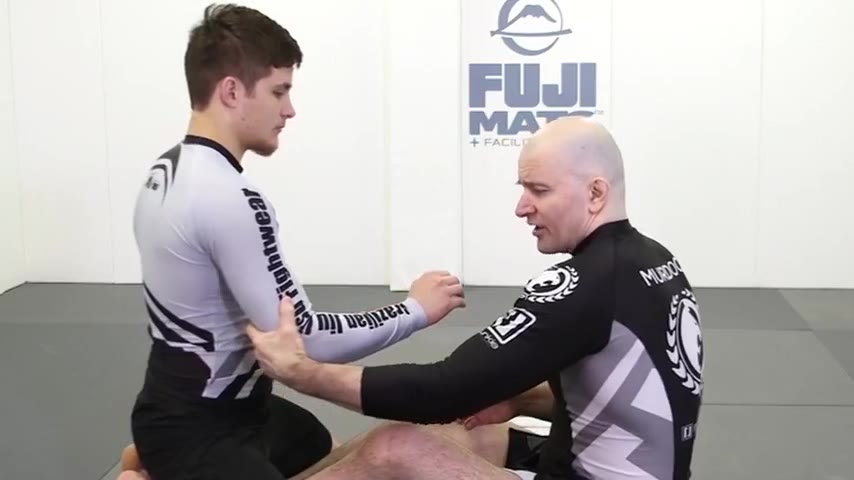 01
 02
 03
 04
 05
 06
 07
 08
 09
 10
 11
 12
 13
 14
 15
How many of these details do you do?
Count the ones you already do in a roll. If three or more are new to you, this course has plenty to teach you.
House code EXTRAXX58 took 58% off this course at checkout on November 11, 2026: $82.74 instead of $197.
Danaher or Craig Jones?
Both are no-gi and $197 (list prices checked November 11, 2026), and both know a triangle can stall. Danaher spends the course making it lock. Craig Jones’ Systematic Submission Dilemmas is built around the other way out: take his legs.
- When the triangle fails. Danaher has the same idea: “every time we feel a triangle is failing, I go directly into my opponent’s lower body” (Volume 1). He gives it two chapters, both ending on an inside heel hook. Craig gives it Volumes 6 and 7.
- Squeezing harder. Danaher: “I can squeeze all day and no strangle is going to happen” when the knee is in the wrong place (Volume 5). Craig, in almost the same words: “If I’m squeezing that hard, there’s something wrong with the position.”
- Five triangles. Danaher builds each of the five from grip to lock, the front one as “the king of the five”. Craig teaches them as half of a two-way threat with the legs.
Leaning toward Craig’s? Read our review of Systematic Submission Dilemmas.
Who should buy it
- Triangles that stall half-lockedThe shoulder line, the angle, his shoulder: why it won’t lock, with the fix.
- Short legsDanaher says his are short for his height. His fix is the shoulder, and his advice for short legs is to start with the rear triangle (Volume 6).
- No-gi playerEvery demo is no-gi, from guard, the top, side, mount and the back.
- White beltClear, but 8 h 43 is a lot.
- Gi playerThe mechanics carry over; no lapel or sleeve grips.
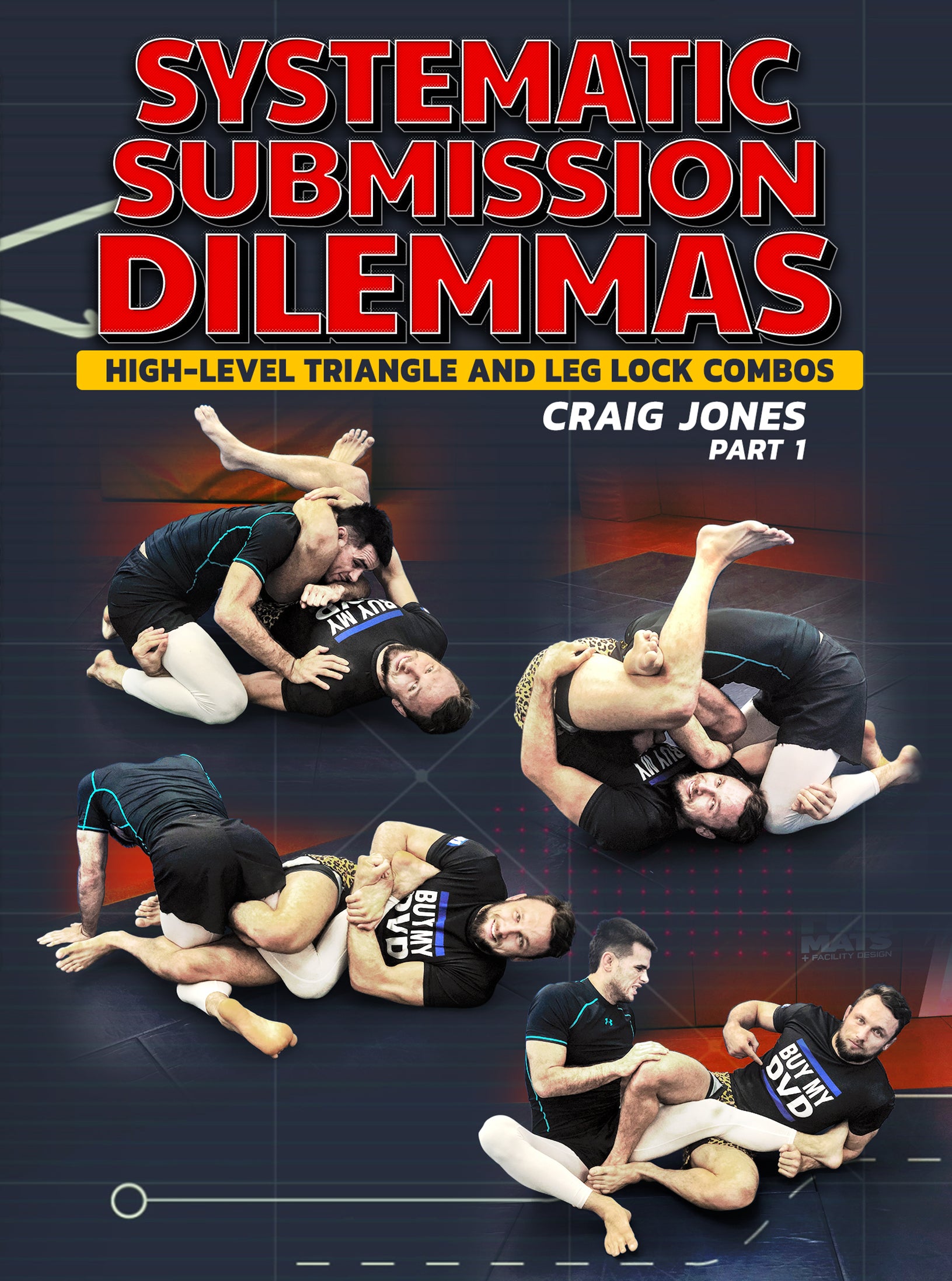 Wants triangles into leg locksTwo chapters here; Craig Jones made two volumes of it.
- Wants it shortVolume 1 alone is 1 h 45, mostly theory and drills.
What buyers and BJJ Reddit say about it
“I’m not tall and have short legs. It was never my go to move. This video completely changed my understanding.” Ken E., a buyer on BJJ Fanatics (September 2022).
“It’s a lot…. It’s a Danaher video but it’s good how it’s laid out.” He watched it through, then used it as a reference: u/LinearCombo on r/bjj (May 2024).
“If you can handle being talked to death go for it.” u/G30Music on r/bjj (2020).
One of the better Enter The System sets, “but don’t financially inconvenience yourself for it.” u/_tinybutstrong on r/bjj (2020).
Both are fair. The money part is why the house code matters: $82.74 instead of $197 on November 11, 2026.
Worth it? The pros and cons
- It shows why a triangle won’t lock, and the fix: both shins pointing the same way (detail 07), your shin above his shoulder line (detail 08), his shoulder out of the triangle (detail 09)
- Built in stages, the same four steps every time, so you can tell where yours went wrong
- Grips that start a triangle on purpose: the two-on-one (detail 01), the inside wrist grip (detail 03), the clamp (detail 05)
- A next move when it still isn’t there: the opposite triangle (detail 10), then the kimura (detail 11)
- Short legs: Danaher says his own are short, and calls the rear triangle the easiest of the five for them (detail 13)
- Long and talky: 8 h 43, and Volume 1 spends its first hour on theory and drills before the five triangles are introduced
- No live rounds and no matches. Craig Jones’ Systematic Submission Dilemmas ends with 1 h 33 of his own matches, also $197
- No-gi only, released in 2019: no lapel or sleeve grips.
 Braulio Estima’s Invisible Triangle Concepts is taught in the gi, four volumes for $79
Triangles: Enter The System (Danaher, 8 h 43)$23Triangles: Enter The System with EXTRAXX58$9Systematic Submission Dilemmas (Craig Jones, 7 h 18)$27His shoulder out, then the lock. House code EXTRAXX58
What’s inside
91 chapters over eight volumes, all no-gi, all studio teaching. Every triangle is built in the same four steps:
- 1Get a working griptwo-on-one, inside wrist, overhook, collar tie
- 2One arm in, one outthe trap triangle: head and one arm inside your legs
- 3From the trap to the lockshoulder line, angle, the figure four
- 4Strangle isn’t there?switch to a joint lock, mostly a kimura
And there are five triangles, in two families. Inside a family you can switch from one to the other; that is how he chains them:
Have one, and you can turn to the other two.
- Frontomote sankaku · Vols 2-4
- Rearushiro sankaku · Vol 6
- Oppositehantai sankaku · Vol 5
Have one, and you have the other.
- Sideyoko sankaku · Vol 7
- Reversegyaku sankaku · Vol 8
Vol 1 · 1:44:59The systemtheory, drills, the five triangles
Theory and drills first: why five, why two stages (the trap, then the lock), solo and partner drills (detail 04). Then the five triangles, the pros and cons of pulling his head down, and going to the legs when the triangle fails.
Vol 2 · 1:28:27Front triangle: finishingthe details that make it tight
Where a stalled triangle gets fixed: the shoulder line (detail 08), the angle that takes his shoulder out (detail 09), shins that point the same way (detail 07), your lower back off the mat. Then the two-on-one from sitting (detail 01) and five chapters against the single leg (detail 12).
Vol 3 · 1:15:28Front triangle: entries from guardgrips, off-balancing, the clamp
One arm in and one out from guard: collar tie, overhook and underhook, the inside wrist grip (detail 03), the push on his knee (detail 02), the clamp (detail 05) and the answer when he holds your leg (detail 06). Then two more entries from guard.
Vol 4 · 1:17:27Front triangle: reacting, and from the toppassing, side, mount, other submissions
The triangle as a reaction when he passes your guard, then from the top: while you pass, four chapters from side position, from mount. Then entries off the threat of another submission, and the switch to the legs that ends on an inside heel hook.
Vol 5 · 36:42Opposite trianglehantai sankaku
When he pushes his shoulder back in: the triangle the other way round, and the walk to north-south (detail 10). Then elbow position, sweeps, and the kimura when the knee sits too high (detail 11). Danaher calls Gordon Ryan’s win over a Gracie probably its most famous use (BJJ Fanatics’ product page names the superfight with Ralek Gracie).
Vol 6 · 1:04:09Rear triangleushiro sankaku
The triangle from behind, the easiest of the five for short legs, Danaher says. From the back and the turtle, side positions, mount, an armlock, passing and the referee’s position. Against locked hands, your leg breaks his grip (detail 13). Then the links to the front and opposite triangles, and joint locks.
Vol 7 · 50:11Side triangleyoko sankaku
Rare in jiu-jitsu, Danaher says, and the most common triangle in judo. The belly-down shift (detail 14), three chapters on attacking the turtle, the link to the armbar, passing, and arm locks.
Vol 8 · 25:34Reverse trianglegyaku sankaku
The one he says scores least in competition, and the tightest when the knee is right (detail 15). Three chapters of entries and the armlocks off it. “Once you set the triangle, top and bottom position become irrelevant.”
Compare to
List prices checked November 11, 2026.
- Systematic Submission Dilemmas by Craig Jones: $197, triangles into leg locks, with his own matches. The full comparison is above. See it on BJJ Fanatics. Or read our review.
- Invisible Triangle Concepts by Braulio Estima: four volumes, taught in the gi, $79. The one to look at if you train in the gi. See it on BJJ Fanatics.
- Lock & Strangle Triangle Mastery by Kieran Kichuk: a newer no-gi triangle course (2024), $127. See it on BJJ Fanatics.

More options in every triangle instructional ranked and all John Danaher instructionals ranked.
Get the next review like this one
New reviews in this format land in your inbox, with the timestamps and clips. You also get the free BJJMore email course and the instructional-platform discounts (worth $46).

BJJMore earns a commission if you buy through these links, at no extra cost to you. This review covers the whole course: all eight volumes (released January 2019).
FAQ
Is Triangles: Enter The System worth it?
Yes, if your triangles get stuck half-locked. It shows why they won’t lock (shin under his shoulder line, no angle, his shoulder still inside) and what to do when he pushes it back in. Skip it if you want something short: it is 8 h 43 of Danaher.
How long is Triangles: Enter The System?
8 hours 43 minutes over eight volumes: 1:44:59, 1:28:27, 1:15:28, 1:17:27, 36:42, 1:04:09, 50:11 and 25:34, in 91 chapters. The front triangle takes Volumes 2 to 4; each of the other four triangles gets one volume.
Does it help if I have short legs?
Yes. Danaher: “if your mechanics are good, there’s a lot you can do to get around this problem of short legs.” He says his own are short for his height. His fix is getting the shoulder out of the triangle, and he tells short-legged people to start with the rear triangle (Volume 6).
Is it gi or no-gi?
No-gi. Every demonstration is without the gi. The mechanics carry over to the gi, but there are no lapel or sleeve grips.
Can I watch Triangles: Enter The System for free?
Only small parts. BJJ Fanatics put five chapters on YouTube in January 2019, about 18 minutes of the 8 h 43: triangle mechanics, wrist controls to triangles, front triangles while passing, rear triangle entries from the back, and the side triangle while passing. What ties them together is in the paid volumes.
Which volume should I start with?
Volume 2 if you already get his head and one arm and it stalls there: the shoulder line, the angle and the lock fill its first half. With short legs, Danaher’s own advice is Volume 6, the rear triangle. Volume 1 can wait.
Danaher or Craig Jones for triangles?
Danaher’s if you want the triangle itself to lock and finish: five triangles, and a joint lock when the strangle isn’t there. Craig Jones’ Systematic Submission Dilemmas if you want a failed triangle to turn into a leg lock, with his own matches as examples. Both are no-gi and $197.
Does it cover the reverse triangle?
Yes, Volume 8 (26 minutes): the reverse triangle (gyaku sankaku), three chapters of entries, and the armlocks off it.
Is there a discount code?
Yes. The house code EXTRAXX58 took 58% off this course at checkout on November 11, 2026: $82.74 instead of $197. BJJ Fanatics rotates these codes, so check the price on the day you buy.
Make the triangle lock
If you get his head and one arm and it stalls there, this course shows the fix: shin above his shoulder line, turn until his shoulder is gone, then lock. Don’t pay list for it.
House code EXTRAXX58: $82.74 instead of $197, tested November 11, 2026