
Home / Reviews / Craig Jones / Power Ride 2.0 Review
Craig Jones Power Ride 2.0 Review: Real Sequel or Cash Grab?
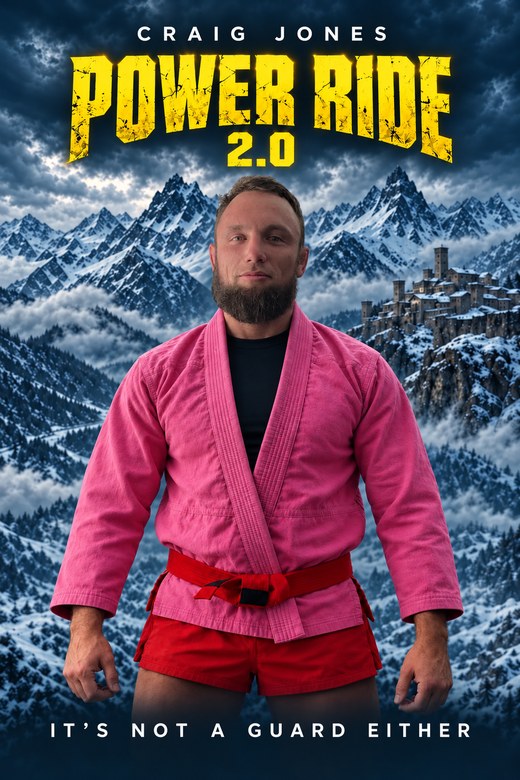
Power Ride 1 is one of the best instructionals ever made. The sequel is about top half guard, not more leg rides. I went through all five volumes, timed every minute, transcribed every word and checked the techniques against real fights. Here’s whether it lives up to the name.

BJJMore earns a commission if you buy through the links on this page, at no extra cost to you. This is a first-watch review of a release that came out on October 21, 2026. I’ll update it after a few weeks of drilling the system, the same way I trained Power Ride 1 before reviewing it.
Jump to a section
At a glance
First-watch verdictPower Ride 2.0
Craig Jones · BJJ Fanatics · released October 21, 2026Craig’s most coherent system since Power Ride 1, wrapped in his thinnest package. Two hours of genuinely smart top half guard teaching, padded with a free promo and 51 minutes of mostly silent live rounds.
A real system in a thin package
It is not a cash grab in the sense that matters most: the system is real. Craig takes one position you already end up in every round, top half guard with a near side underhook, and turns it into a pin with four finishes that feed into each other. It’s the clearest throughline he has built since Power Ride 1.
But the product around that system is thin. Only about two of the three hours are teaching. The first 12 minutes of Volume 1 are the same essay he posted for free on YouTube, and the 51-minute live-round volume has almost no narration. One camera often films Craig’s back right when the detail matters. At $197 that’s about $98 per hour of teaching, double what Power Ride 1 cost. With a sitewide code it drops to roughly $41 per hour, and then it’s an easy yes for anyone who plays top. Great system, padded product: don’t pay list.
On October 26, 2026 the house code EXTRAXX58 took 58% off at checkout: $82.74 instead of $197. House codes rotate, so check the price on the day you buy.
You play top and keep landing in half guard, you’re 30+ or training less and want a pin that costs you nothing, you train no-gi or MMA, or you already own Power Ride 1 and want the half guard version of the same philosophy. Best at a sale price.
You expect more leg rides (that’s Power Ride 1), you want a complete half guard passing course, you need IBJJF points from top half, or you can’t stand Craig’s humor. It’s louder and cruder here than in any of his other sets.
- One position, one idea, one closed loop of finishes. A real system, not a bag of moves
- Specific, testable details: thumb direction, head at the elbow, palm-down arm triangle grip
- Three-quarter mount instead of mount to kill the bridge is a small change with a big payoff
- The short D’Arce section fixes the bicep D’Arce’s biggest problem: the forehead-down sprawl
- Energy-efficient by design. Craig built it because he trains less, and it shows
- Islam Makhachev wins UFC fights with exactly this position, so the idea is proven at elite level
- About 2 hours of teaching for $197. Power Ride 1 gave you roughly 4
- Vol 1 opens with the 12-minute promo that is free on YouTube
- Vol 5 is 51 minutes of live rounds with 725 spoken words. Sixteen minutes of it are free on YouTube too
- One static camera, often behind Craig’s back on the key detail; watermark sometimes over the action
- Repetitive riffs: the “mouth guard, shin guard” bit appears four times
- Not new in principle. Danaher and Gordon have taught half guard top as a pin for years
Where the 3 hours actually go
The product page says five volumes. What it doesn’t say is how that time splits. I timed every file and transcribed every word, because “3 hours” means very different things depending on how much of it is teaching.
| Volume | Length | Words spoken | Talking | What’s in it |
|---|---|---|---|---|
| 1. Near side underhook | 42:16 | 5,040 | 71% | 0:00-11:46 is the YouTube promo, then the NSU pin, three-quarter mount and arm triangle setup |
| 2. Octopus killer & short D’Arce | 20:32 | 2,580 | 72% | Why octopus fails against a flat half guard, then the short D’Arce. About 5 minutes of seated talk |
| 3. The Quad Lemma | 39:19 | 5,027 | 73% | The densest volume: crossface details, slide-by, kimura, von flue, tripod pass, arm triangle |
| 4. Top half D’Arce | 29:48 | 3,883 | 71% | Knee shield pins, the leg-trap D’Arce, mount without the underhook, “half guard is everywhere” |
| 5. Live rounds | 50:40 | 725 | 6% | Craig rolling top half against several partners, one 4-minute debrief at 33:51 |
| Total | 3:02:35 | 17,255 | ≈ 2 h 00 min of teaching (66% of the runtime) |
Two numbers jump out. Volume 5 has 725 words in 51 minutes, so someone is talking only 6% of the time, against 71 to 73% in the teaching volumes. And the 11:46 promo at the start of Volume 1 is word for word the “I Was Wrong About Half Guard” video on the B-Team channel.
Live rounds aren’t worthless. Seeing the pin hold against resisting partners is useful, and some people love them. But without commentary you’re watching footage, not instruction. For comparison, Power Ride 1 gave you roughly 4 hours of teaching for the same $197. The fix is the price: at the $82.74 we got with a code on October 26, two hours of this teaching comes to about $41 an hour, less than Power Ride 1 at list.
The idea: half guard is a pin, not a guard
The whole instructional hangs on one reframe. Every other “guard” in the world is defensive: mouth guard, shin guard, security guard. Only in jiu-jitsu is a guard where you attack from. And a flat half guard, with the bottom player’s underhook gone and his hips stuck, isn’t half an offensive position. It’s barely a quarter of one.
“Half guard is a pin. It is not a guard.”Craig Jones, Vol 2 at 9:46
So instead of racing to pass, you stay. Craig’s argument for why that’s smart is the best idea in the set: from side control, the bottom player can turtle and get up, but from half guard he can’t. To turn away he needs his top hip in front of his bottom hip, and the half guard leg he’s clinging to is exactly what stops that. The leg isn’t his weapon. It’s his anchor.
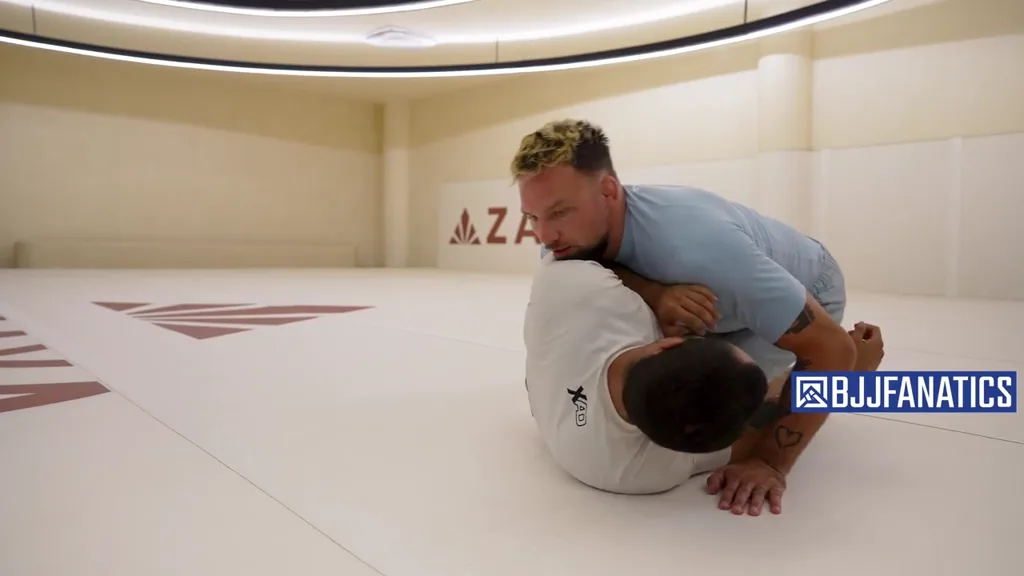
Points are the reason we ignore this. Every ruleset rewards the pass, so we train to leave half guard as fast as possible. Craig’s point is that you can hold someone in a miserable position and score nothing, or in a comfortable one and score four. If you care about submitting people, take the misery.
He’s also clear about what this isn’t: “This isn’t instead of passing. It’s actually how you pass and consolidate.” You still pass, just later, on your terms, after the guy is tired. And he says plainly that it’s not Power Ride 1. Power Ride 1 created new grey areas with leg rides; this one turns a position everybody knows into a grey area.
What’s inside, volume by volume
Timestamps are from the downloaded files, so you can jump straight to the parts you want to rewatch.
Near side underhook
After the promo, Craig credits Shawn Williams for the near side underhook (NSU) and spends half an hour on how to get it and why it’s worth it. The entries are the best part: crossface so hard that the bottom player cups it, then slip under the elbow. If his elbow stays tight, cup his triceps for a second to pause his pummel, then dive the underhook as he re-pummels.
Then the arguments. With the NSU and your head on the correct side he can’t turn into you or away from you. Your ankles are safe from single X and ashi entries. His butterfly hook stops mattering because you just change angle, or hook the leg if it’s a freakishly strong one. Craig calls it the worst half guard for the bottom player, and notes it scores nothing in IBJJF.
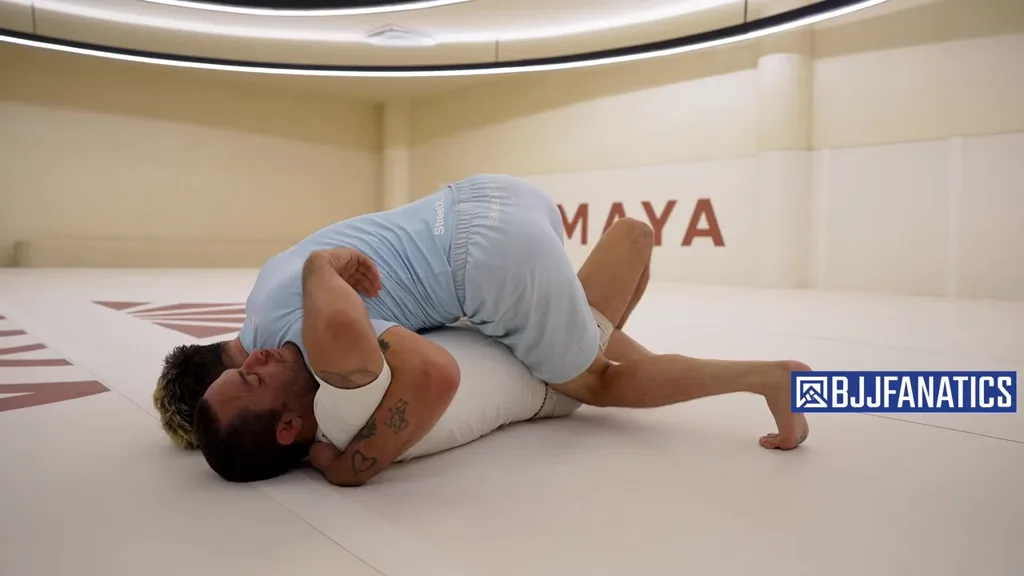
The second half covers the three-quarter mount (more on that below) and his number one arm triangle setup: let him think the bridge works, and when he turns toward turtle, he circles himself into the arm triangle grip while your foot drags his hips back.
Octopus killer and the short D’Arce
Craig sold us Octopus Guard twice. Now he shows how to shut it down, and the answer is almost insultingly simple: stay in half guard. The octopus needs the bottom player to turn in and get his top hip in front of his bottom hip, and the half guard leg prevents exactly that. If he gets there anyway, sit on his chest. Expect a few jabs at Gordon Ryan’s octopus-counter instructional along the way.
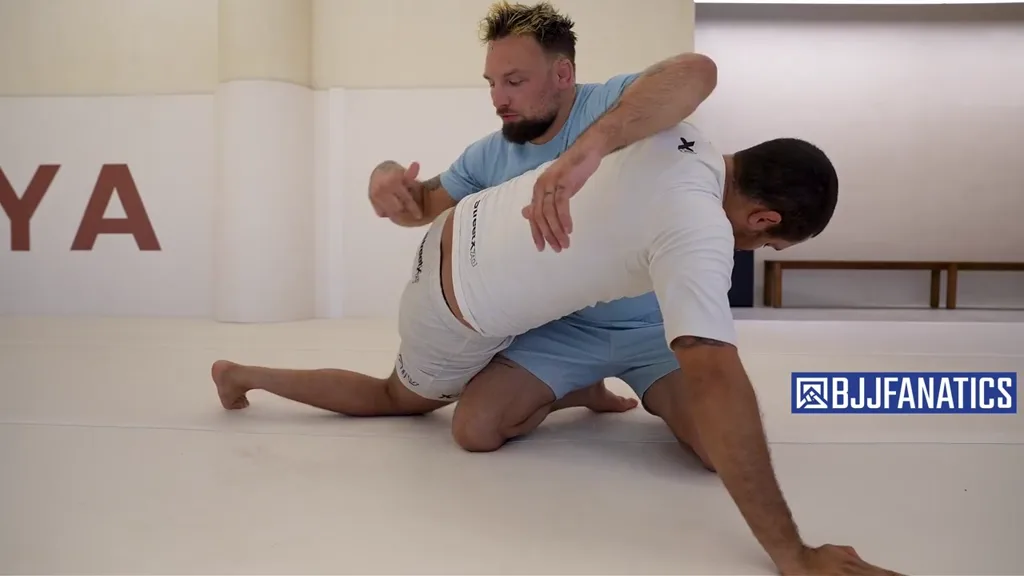
The second half is the short D’Arce, and it’s the best ten minutes of the volume. Craig uses Charles Oliveira vs Arman Tsarukyan to show why the classic bicep D’Arce fails: the defender puts his forehead on the mat and sprawls, and you can’t bend his neck. The short version uses a shallow grip, which Craig compares to the Schultz, and replaces your elbow on his head with your armpit. When he sprawls, his own defense tightens the choke. In Craig’s words: “That defense puts the D’Arce on.”
The Quad Lemma
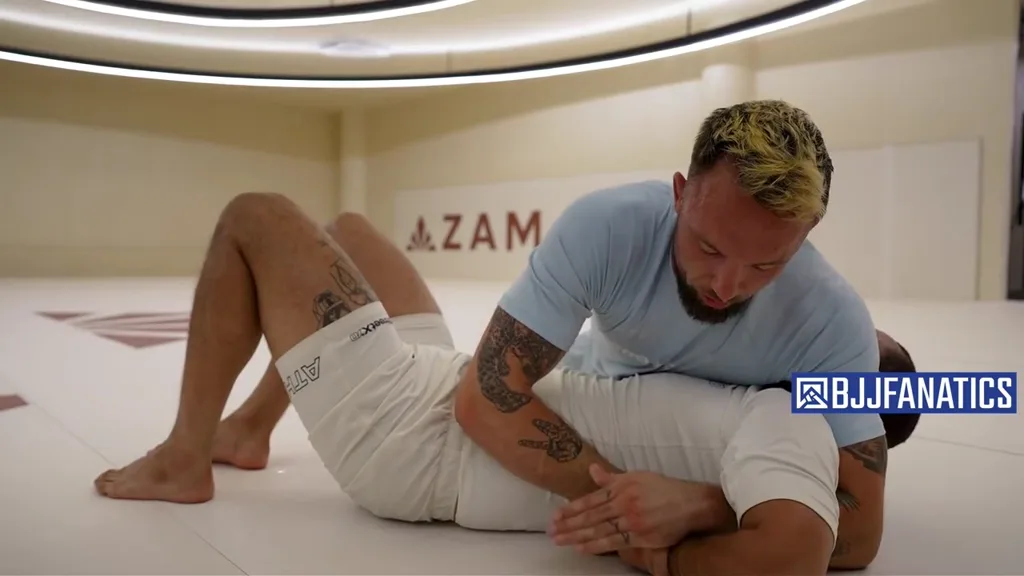
If you only watch one volume, watch this one. It’s Craig’s version of the Islam Makhachev half guard series, and it’s where the system becomes a loop instead of a list: von flue choke, tripod pass, kimura and arm triangle, all from the same crossface pin. Defend one and you feed another.
It starts with grip details that alone justify the volume. Cup the near shoulder instead of overreaching for the far armpit, because the overreach is what lets the bottom player use a butterfly hook to send you to his legs. Keep your hips on the floor and your weight on him. Then the slide-by: not a push past the arm, but rolling your weight forward until he pushes back, then following that push and posting your head on the mat at his elbow.
From there, his thumb tells you everything. While it points at his head he can’t bring the arm back. The moment it turns down to pull the arm in, you catch the wrist (“Spider-Man shooting web”), plant it and work a motorcycle grip toward the kimura. The kimura finish is elbow to elbow with your weight forward, not the classic sit-back that loses the pin.
Top half D’Arce
Volume 4 deals with knee shields and the problems the first three volumes leave open. Shields, Z-guards and butterfly hooks are just obstacles: wedge your knee into his hip, drag his leg with your foot, fall to an elbow, step over and pinch the knees. Then “five ways to arm triangle, baby”, which is close to honest.
The standout is the D’Arce off a trapped leg. Craig traps the bottom leg first and only then looks for the choke, comparing it to heel hooks: get the heel, then build the position. He calls it his “number one top position D’Arce setup for me this year.” The volume ends with mount without the underhook and a short “half guard is everywhere” section: after a double leg, out of side control escapes, even out of leg lock scrambles.
Live rounds
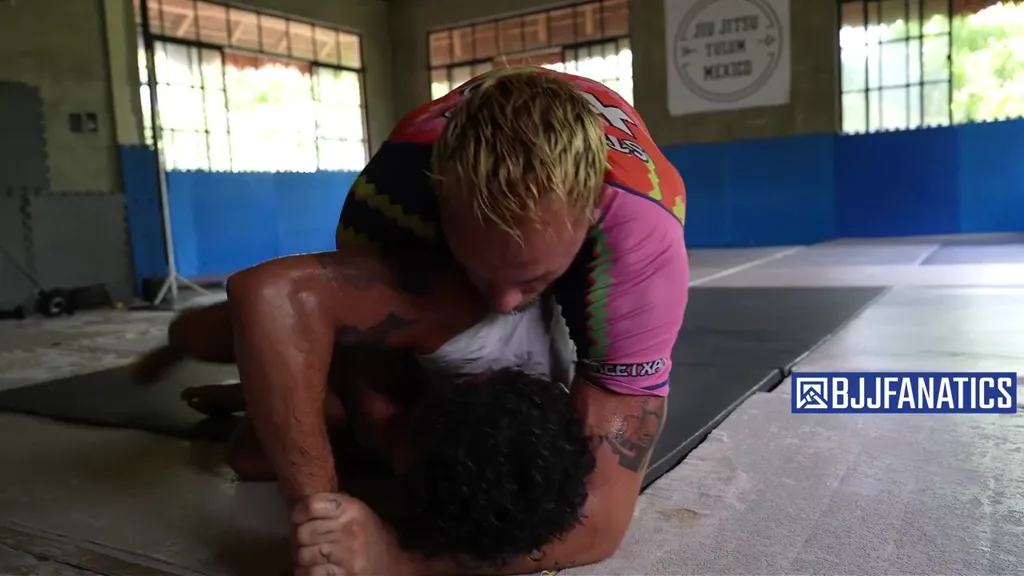
Fifty minutes of Craig rolling top half against several partners in several gyms, filmed handheld. You do see the system work: partners getting flattened, arm triangles from the three-quarter mount, a lot of frustrated faces. But there’s almost no voice-over. The one useful stretch is a four-minute debrief at 33:51, where Craig explains to his partner why he never takes the seatbelt and how the “closed loop” works.
10 details that are worth the money
From first grip to the finish: first how you grab him as you come in (1 to 2), then what to do when he bridges (3 to 4), then how you win his arm (5 to 7), then the chokes (8 to 10). If you’re deciding whether Power Ride 2.0 adds anything to your game, count how many of these you already do.
Cup the shoulder, don’t overreach
Cup the near shoulder instead of reaching for the far armpit, so he can’t get his thumbs in your armpit and butterfly-hook you to his legs.
Vol 3 · 1:10Pause his pummel
Cup his triceps for a split second, and the moment he tries to re-pummel, dive the near side underhook and climb.
Vol 1 · 16:17Three-quarter mount, not mount
Keep one leg trapped, hips up and weight driving into his hip, so when he bridges there’s nothing to lift you with.
Vol 3 · 34:28Let the bridge work, a little
Ease off just enough that he bridges and turns toward turtle, and he turns straight into your arm triangle grip.
Vol 1 · 31:58Head at the elbow
Forehead on the mat right at his elbow: every time he tries to bring the arm home, your head is in the way.
Vol 3 · 10:35Read the thumb
Wait for his thumb to turn down as he pulls the arm back in, because that’s the moment the wrist comes to you. Catch it.
Vol 3 · 12:34Kimura elbow to elbow
Push his hand toward his shoulder and bring your elbow to his elbow, weight forward, instead of sitting up and giving away the pin.
Vol 3 · 19:08Palm down on the arm triangle
Choking hand palm down closes the gap at your bicep, then finish with falling body weight instead of a squeeze.
Vol 3 · 26:58Shallow D’Arce
Bring your arms together with your armpit on his head instead of reaching deep, so the grip stays shallow and his sprawl tightens it.
Vol 2 · 15:09Trap the leg first
Pin his bottom leg before you look for the D’Arce: he can’t turtle away, and the grip gets easier to find.
Vol 4 · 15:32These ten come from about two hours of teaching. If three of them are new to you, the instructional pays for itself at the code price.
On October 26, 2026 the house code EXTRAXX58 took 58% off at checkout: $82.74 instead of $197.
Power Ride 1 vs Power Ride 2.0
The name suggests a continuation. It isn’t one, at least not technically. Same philosophy, different position, and a much smaller product.
| Power Ride (2022) | Power Ride 2.0 (2026) | |
|---|---|---|
| Position | Leg rides, turtle, belly-down back | Top half guard with the near side underhook |
| Core idea | Pin on the legs, not past the legs | Half guard is a pin; don’t rush the pass |
| Runtime | ≈ 4 hours, 6 volumes | 3 h 03 min, 5 volumes (≈ 2 h teaching) |
| Main finishes | Arm triangle, D’Arce, belly-down RNC | Arm triangle, D’Arce, short D’Arce, kimura, von flue |
| Novelty | Genuinely new to most BJJ players | Known position, new emphasis |
| Cost per teaching hour | ≈ $49 | ≈ $98 |
| Our rating | 10/10 (trained for 3 months) | 8/10 (first watch) |
| Price | See today’s price → | See today’s price → |
They fit together well. Power Ride 1 gives you control when the opponent turtles or you’re on his legs; Power Ride 2.0 gives you control in the position you land in after most passing exchanges. The arm triangle and D’Arce are the main finishes in both. If you can only buy one, buy Power Ride 1 first, unless you already spend most of your rounds on top of someone’s half guard.
Is Craig past it? Why I went in skeptical
Honestly, I was skeptical. Power Ride 1 is a top-5 instructional for me, maybe number one. But some of Craig’s recent content has felt a bit flat, and he’s training and competing a lot less than he used to. A “2.0” from someone in that phase can easily be a cash-in on the name.
The surprise is that the instructional is built on exactly that. Craig says it openly in Volume 1: “I just started training less. And I wanted moves that worked.” He turned 35, his ankles aren’t what they were, and he found top half guard to be the safest and most energy-efficient pin he has. In Volume 4 he jokes about faking an injury so he doesn’t have to roll at the Mexico camp.
So the falloff is the premise, not a hidden weakness. That’s also why it might suit a lot of readers better than his athletic leg lock material: it’s a system for people who can’t out-scramble 22-year-olds anymore. One commenter under the promo put it well: “I know a lot of 35+ yo brown belts that will be happy about this.” (@TristanGoingNorth on YouTube)
The live rounds show it working against his own training partners, not elite competition. For the elite proof you need to look at the MMA fighter Craig keeps naming, and I’ve put those clips below.
Production: good lights, bad angles
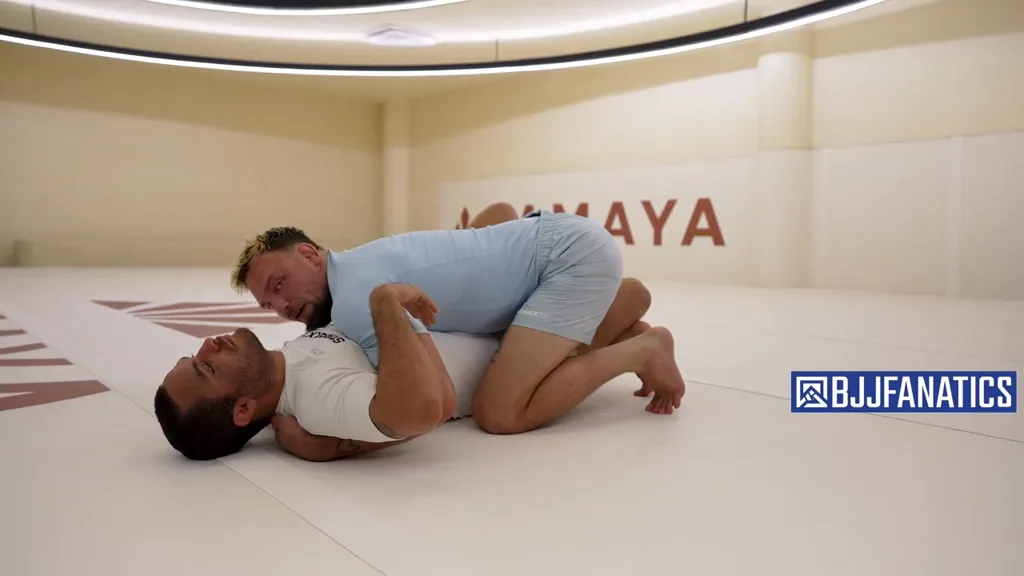
This one was shot on location during Craig’s Mexico camp, not in a studio. The lighting is genuinely good: a soft light strip runs along the ceiling, the room is bright and the colors are clean. The opening essay is filmed outdoors by a river and looks better than most YouTube productions.
The camera is the problem. There’s one fixed angle, low on the mat, and it rarely moves. When Craig rolls to the wrong side, you get his back instead of the detail he’s explaining.
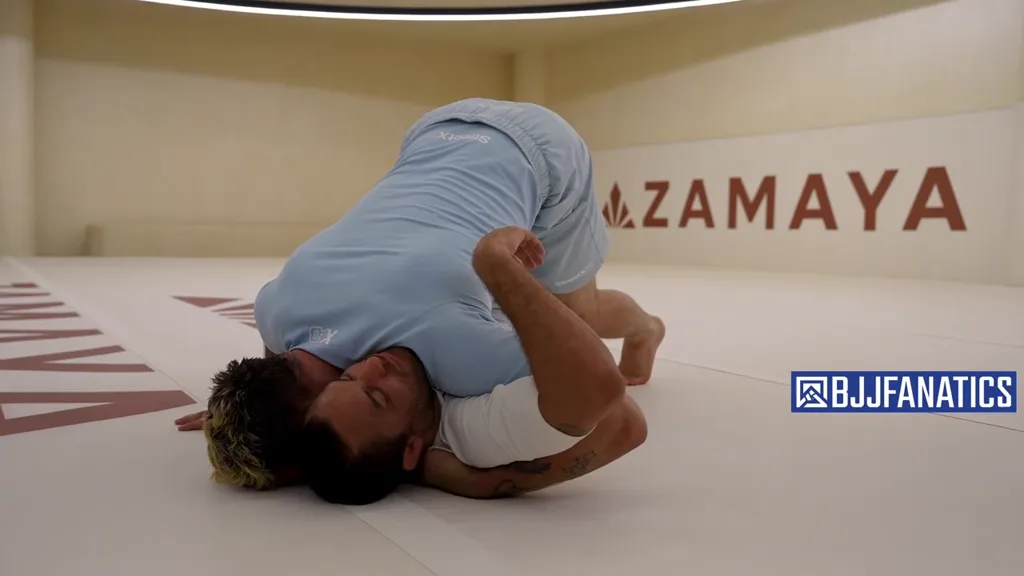
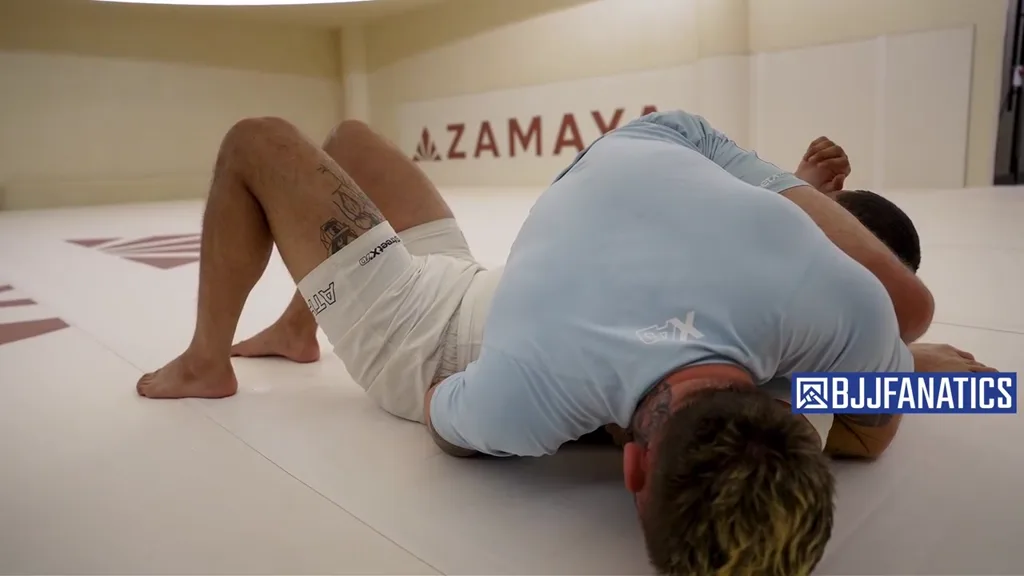
Three other things you’ll notice. In Volumes 2 and 4 the camera sits at the edge of the mat, so you see the wall corner, a bench and a water dispenser instead of a clean background. During seated explanations his partner is half out of frame. And the BJJ Fanatics watermark sits in the bottom right corner, which is sometimes exactly where the head and arm are.
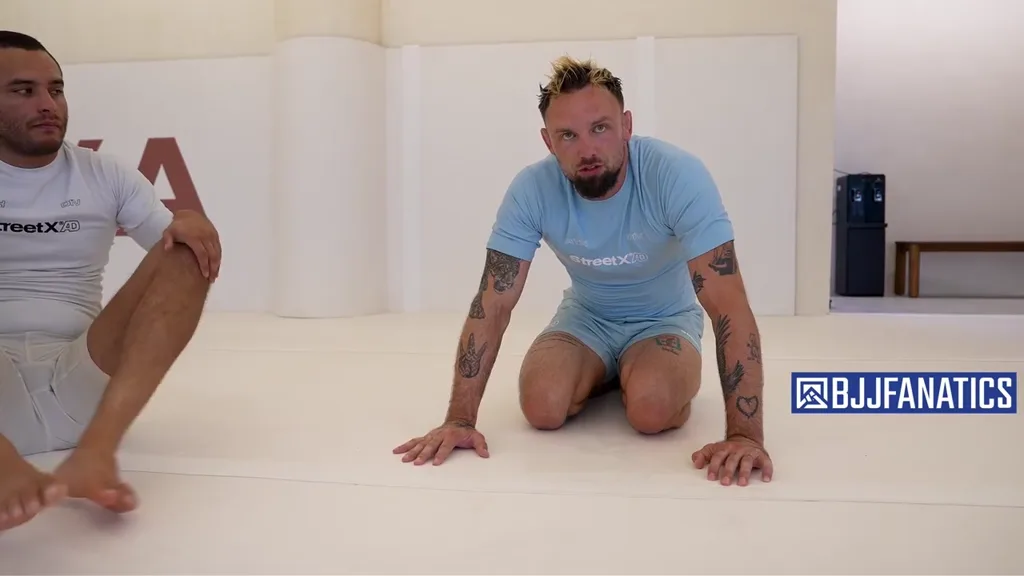
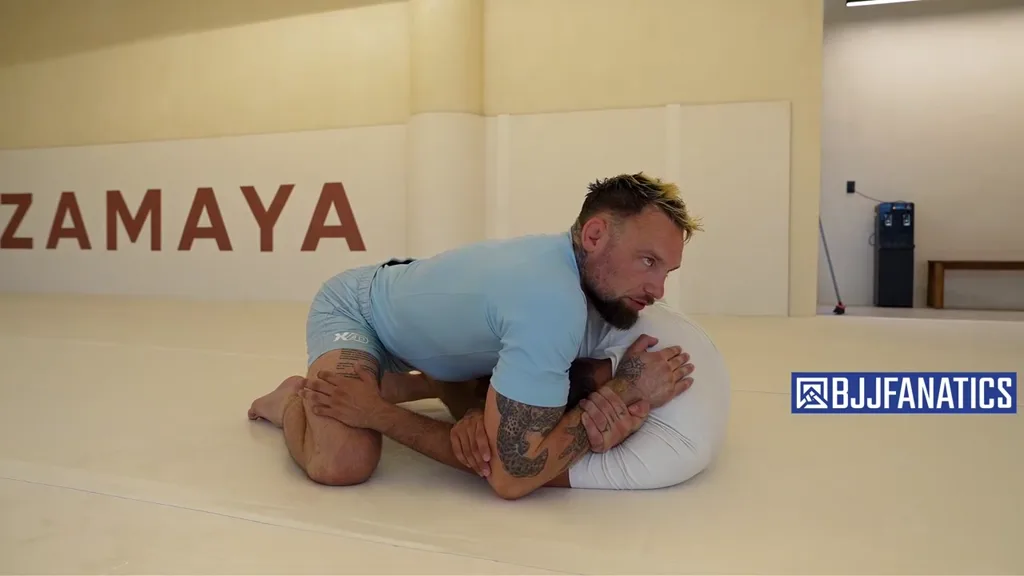
The microphone shapes the teaching too. Twice Craig demonstrates something slightly wrong so you can hear him: he lets go of the crossface in Volume 3, and in Volume 1 he admits he holds his head in the wrong spot “because you won’t be able to hear me.” A second camera and a lavalier would have fixed most of this. For a $197 flagship from Craig, that’s a strange place to save money.
Proof at the highest level: Islam Makhachev
Craig is open about where this comes from. He calls Volume 3 “a cheap knockoff of Islam Makhachev” and keeps returning to his fights. That’s good news for us, because Islam’s top half guard is all over official UFC footage. It also shows up in pure grappling. Each clip below starts at the moment that matters.
Not just MMA: William Tackett vs Kyle Chambers (UFC BJJ 2)
The same chain in a pure grappling match. Tackett keeps a heavy crossface from chest-to-chest half guard so Chambers can’t use his underhook, posts on the elbow to win the head and arm, and knee cuts toward mount with the arm triangle. When Chambers turns away from the choke, Tackett takes the back. That’s the “keep them in the loop” idea from Volume 3, under real pressure.
UFC BJJ 2 · official UFC uploadWilliam Tackett vs Kyle ChambersCrossface, head and arm, knee cut to the arm triangleStarts at 1:49:31Official UFC upload of the full UFC BJJ 2 event. Found through OutlierDB, which tags competition footage by technique.
Arm triangle from top half: Islam vs Drew Dober (UFC 259)
Craig cites this one in Volume 3: Dober thinks he’s safe in half guard and doesn’t feel the arm triangle building. Listen to the commentary: they describe opponents simply accepting the bottom position after enough pressure. That’s the “make them carry your weight” idea in one sentence.
UFC 259 · official UFC uploadIslam Makhachev vs Drew DoberArm triangle from top half guardStarts at 1:29:05Official UFC upload “Every Islam Makhachev Fight”, starts at 1:29:05.
Arm triangle to win the title: Islam vs Charles Oliveira (UFC 280)
After the knockdown Islam follows Oliveira to the mat, and the commentators are still talking about him having to pass when the arm triangle is already locked. The replay shows the head-to-head pressure Craig teaches in Volume 3.
UFC 280 · official UFC uploadIslam Makhachev vs Charles OliveiraArm triangle for the titleStarts at 2:05:05Same official upload, starts at 2:05:05.
The quad lemma live: Islam vs Nik Lentz
The cleanest real-world example of the loop I found. From half guard, Islam digs his head in for the arm triangle, switches to a von flue-style shoulder crush when Lentz defends, then climbs to mount and the back. Arm triangle, von flue, pass: three of Craig’s four options in thirty seconds.
UFC 208 · official UFC uploadIslam Makhachev vs Nik LentzArm triangle, von flue, then the passStarts at 32:25Same official upload, starts at 32:25.
The kimura from half guard: Islam vs Jack Della Maddalena (UFC 322)
Craig opens the instructional with this fight and its long stretches of half guard control. Against the fence, Islam goes for the kimura from top half. It’s the kimura branch of the quad lemma, against an elite welterweight.
UFC full fight · official UFC uploadIslam Makhachev vs Jack Della MaddalenaKimura from top half guardStarts at 20:05Official UFC full fight upload, starts at 20:05.
Watch these free videos before you buy
Craig and the B-Team put a surprising amount of this online for free. That’s good for you either way: if these don’t click, you can skip the instructional with a clear conscience.
1. Craig’s free seminar at the same gym (October 2026)
This is the one to watch. Two weeks before Power Ride 2.0 came out, a full 75-minute seminar Craig taught at the same gym in Tulum went up on YouTube. The first half hour is octopus guard and why half guard shuts it down. From 45:16 he calls top half guard the best control position and teaches the near side underhook, the slide-by, the tripod pass and the arm triangle from three-quarter mount. It’s looser than the instructional, but it’s the core of Volumes 1 to 3 for free.
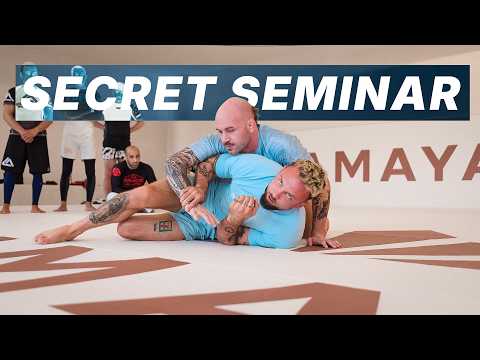
“Craig Jones Full Seminar at Zamaya Tulum, Mexico” on the Everyday 24 Seven channel, starts at the half guard section (45:16).
2. The promo: “I Was Wrong About Half Guard (and Dagestan)”
The full 12-minute essay that also opens Volume 1, with David Foster Wallace’s “This Is Water” as the hook. If the idea doesn’t grab you here, the instructional won’t change your mind.

3. “Ride Like a Dagestani (Without the Cardio)”
Sixteen minutes of the Volume 5 live rounds, set to music. It’s the best preview of what the pin looks like against resistance, and it covers a good chunk of what Volume 5 offers.

4. The “Dagestani D’Arce” breakdown (November 2025)
A B-Team video from last year in which Craig explains the same short D’Arce as in Volume 2, with the same Tsarukyan vs Oliveira example. Craig even mentions in Volume 2 that he has shown it on YouTube before. Watch this one and you have a decent version of Volume 2’s best section for free.

Get the next review like this one
New reviews in this format land in your inbox, with the timestamps and loops. You also get the free BJJMore email course and the instructional-platform discounts I use myself (worth $46).
The skeptic’s case (and my answer)
The release is too new for independent reviews, but the comments under Craig’s promo already show the two main objections.
“Basically copying danaher and Gordon Ryan’s points about chest to chest half guard and rebranding it”
@benhallo1553 on YouTube, under the promo
“Translation: Force top half guard. Stay make them tired. Side control sucks because they can escape easier so don’t pass to side control.”
@TravC16 on YouTube, one of the most-liked comments (316 likes)
Both are partly right. Half guard top as a pinning position isn’t new: John Danaher’s Half Guard Passing and Dynamic Pins has “pins” right in the title, and Gordon has said similar things for years. And yes, the one-line summary is “stay in half guard and make them tired”.
But a one-line summary isn’t a system. What Power Ride 2.0 adds is the refusal to pass early, the three-quarter mount ride, letting them bridge into the arm triangle, the thumb-reading kimura entry and the short D’Arce for turtlers. Those details are what turn “stay there” into something you can actually do against someone fighting you. There’s a second catch: a free seminar from the same gym covers a lot of the same ground. Craig’s instructional is more structured and has the details the seminar skips, but you can try the core idea before paying. The rebranding complaint lands harder on the product than on the content: calling this “Power Ride 2.0” sells it as the sequel to a 10/10, when it’s really a new, smaller, half guard instructional.
Who should buy Power Ride 2.0 (and the prerequisites)
It’s the right buy if you are:
- A top player who lands in half guard a lot and keeps losing it during the pass
- 30+, injured or training less, and you want control that doesn’t cost cardio
- A no-gi or MMA grappler: half guard top is where strikers and wrestlers end up after takedowns
- A Power Ride 1 owner who wants the same philosophy applied to a position you already know
- An arm triangle or D’Arce player looking for a reliable place to set them up
Prerequisites are lighter than for Power Ride 1, because you don’t need to pass to anywhere special. You need to get to top half guard, which happens by accident in every roll. What helps a lot is a basic arm triangle and D’Arce, since those are the finishes the pin produces. If you can’t finish either yet, start with our arm triangle guide.
Skip it, or buy something else first, if you compete mainly under IBJJF rules and need points from top half, if you want a complete half guard passing curriculum, or if you play bottom half guard and want the other side of the story. In that last case, look at our best half guard instructionals.
Compare to
Power Ride by Craig Jones ($197)
The original, and still the better buy if you own neither. Leg rides, turtle rides and a full pinning philosophy in about 4 hours. Read our hands-on review.
Half Guard Passing and Dynamic Pins by John Danaher ($197)
Same position, classic approach: Danaher treats half guard top as a pin on the way to passing. More complete on the passing side, far less focused on staying and submitting.
The Guard Passing Anthology: Half Guard by Lachlan Giles ($79)
The budget pick if passing half guard is your real problem. Lachlan’s breakdowns are as clear as ever, at less than half the price.
Top Half Guard by Neil Melanson ($127)
A catch wrestler’s take on the same position. A useful second opinion next to Craig’s arm triangle-first approach.
Darces From Everywhere by Kade & Tye Ruotolo ($127)
If the D’Arce sections hooked you, this goes much wider on the choke itself, from more positions than top half.
Best Craig Jones Instructionals Ranked
Every Craig Jones release ranked, with where Power Ride 2.0 lands once the mat test is done.
Mat test status
I trained Power Ride 1 for three months before I reviewed it. This review is based on watching, timing and transcribing all five volumes, so the score is a first-watch score. What I’m testing in live rolling before the update:
- The NSU entries from Vol 1: crossface cup and the triceps pause
- Three-quarter mount instead of mount against explosive training partners
- The short D’Arce against people who sprawl with their forehead down
- The thumb-reading kimura from the quad lemma
The ranking position in our Craig Jones list follows after that test.
FAQ
Is Power Ride 2.0 a sequel to Power Ride?
Only in philosophy. Power Ride (2022) is about leg rides, turtle rides and pinning on the legs. Power Ride 2.0 (2026) is about top half guard with the near side underhook. Craig says it himself in Volume 1: “It’s not Power Ride 1.” The shared idea is control over points, with the arm triangle and D’Arce as the main finishes in both.
How long is Power Ride 2.0?
3 hours 3 minutes across 5 volumes. About 2 hours of that is teaching. The first 11:46 of Volume 1 is the promo video that’s also free on YouTube, and Volume 5 is 51 minutes of live rounds with very little commentary.
What techniques does Power Ride 2.0 cover?
The near side underhook pin from top half guard, riding the hips, three-quarter mount to kill the bridge, preventing the octopus guard, the short D’Arce, the “Quad Lemma” (von flue choke, tripod pass, kimura and arm triangle from the crossface pin), knee shield pins, the D’Arce from a trapped leg, and mount without an underhook.
Is Power Ride 2.0 worth $197?
The system is worth it, the package at full price is a stretch. You pay about $98 per hour of actual teaching, roughly double Power Ride 1. Almost nobody pays list, though: on October 26, 2026 the code EXTRAXX58 took 58% off ($82.74), which makes it a good buy for anyone who plays top. Codes rotate, so check the price on the day.
Should I buy Power Ride or Power Ride 2.0 first?
Power Ride first for most people: it’s longer, more original and the better instructional overall. Buy Power Ride 2.0 first if you already spend most rounds on top of someone’s half guard, if you’re older or training less, or if you fight MMA.
Is Power Ride 2.0 good for beginners?
White belts can use the basic pin, because everyone ends up in half guard. The finishes and the riding details make more sense from blue belt up, once you have a basic arm triangle and D’Arce.
Does Power Ride 2.0 work in the gi?
It’s taught in no-gi, but the near side underhook, crossface, three-quarter mount and kimura all work in the gi. The short D’Arce works too, though gi grips give the bottom player more ways to stall.
Does top half guard score points?
No. Holding top half guard scores nothing under IBJJF or ADCC rules, which is exactly Craig’s point. The system is built for submissions, sub-only and MMA. In a points match you still pass eventually, just later and with a tired opponent.
Make them carry your weight
If you live on top and keep losing people during the pass, this is the most useful two hours Craig has put out since Power Ride 1. Don’t pay list for it.
On October 26, 2026 the house code EXTRAXX58 took 58% off at checkout: $82.74 instead of $197.