
Home / Reviews / The 2026 Ranking
Best Wrestling Instructionals for BJJ: Top Picks, Proof, and Who Each One Helps
Eleven wrestling courses for jiu-jitsu, ranked by what they fix: people who turtle and stand up on you, people who escape from under you, and takedowns from the feet. Every pick says who it’s for and who should skip it.

BJJ More earns affiliate commissions when you buy through the links on this page, at no extra cost to you. It does not change the rankings: every pick is judged on what it teaches, who it suits and what it costs.
Jump to a pick
- 1. The Anti-Wrestling Equation
- 2. Power Ride
- 3. The Grappling Continuum
- 4. Wrestling For BJJ (Hudson Taylor)
- 5. Effective Wrestling For Gi Jiu-Jitsu
- 6. Closing The Gap
- 7. Dynamic Wrestling Takedowns For BJJ
- 8. Wrestling For BJJ (Jeff Glover)
- 9. Wrestling For BJJ (Vlad Koulikov)
- 10. Precision Wrestling For Jiu Jitsu
- 11. Wrestling Fundamentals From The Bad Guy
- How I ranked these
- Comparison table
- Find your pick
- FAQ
The top picks, up front
November 2026The Anti-Wrestling Equation
Craig JonesWhen people turtle, post on their hands and stand up: keep them down and take the back. Of everything I’ve watched for standup, it helped mine the most.
7h 00m · 8 vol · blue belt and up · $$Power Ride
Craig JonesPin the legs so his feet never touch the mat, ride the turtle, then finish. The pins worked for me on day one.
4h 09m · 6 vol · blue belt and up · $$The Grappling Continuum
Shawn WilliamsLearn to shoot from scratch: stance, hand fighting, then the double and the single, finished without giving up the guillotine.
3h 19m · 6 vol · all levels · $$Most BJJ players avoid standup. They pull guard, accept bottom, and hope for the best. That works until someone pins you flat and rides out the clock, or turtles, stands up and walks away from you. Wrestling fixes that, but the wrong course wastes your money on shots that get you guillotined.
The short version: The Anti-Wrestling Equation if people turtle and stand up on you, Power Ride if they escape once you’re on top, The Grappling Continuum if you want to learn to shoot. Adam Wheeler is the gi pick, J’Den Cox the $37 one.
How I ranked these
One question sets the order: does the wrestling work in a jiu-jitsu round? A double leg that hands your partner a guillotine, or a pin that only scores in folkstyle, counts for less here than a front headlock that ends on the back.
#1 and #2 are the two I’ve reviewed in full, each with clips from the course on this page and a full review. The other nine are ranked on what they teach (their chapter lists), who they suit and what they cost. Every pick says who should skip it.
Scope: 11 wrestling courses on BJJ Fanatics, ten for no-gi and one built for the gi. Prices and chapter lists checked on 3 November 2026.
The Anti-Wrestling Equation
Craig JonesJiu-jitsu players wrestle better every year: in turtle they post on their hands and stand up. Craig rebuilds the front headlock, the turtle, the rear body lock and the back take for that, with simple mat returns that work in jiu-jitsu. To beat people who wrestle, he teaches a lot of wrestling.

What it covers
Eight volumes in the order of a scramble. Volumes 1 and 2 get you to his head: snap downs, Russian ties, from seated and while passing. Volume 3 is four-point (anaconda, kata gatame, ankle picks) and Volume 4 the turtle: on his hands you attack the neck, on his elbows you go behind. Volume 5 is the chokes (anaconda, Peruvian, D’Arce), Volume 6 the rear body lock, with trips and lifts that put him back on the mat, and Volumes 7 and 8 the mat returns, the hooks and the back.
Why it stands out
- Built for how people roll now: they post on their hands and stand up, and every volume has an answer
- One read for the whole turtle: on his hands, attack the neck; on his elbows, go behind
- A full volume on the rear body lock: trips and lifts that put him back down, then the back
- Most of it starts from his reaction, not your speed: good news if you’re older or less athletic
What surprised me: it’s also one of the best wrestling-for-jiu-jitsu courses I’ve watched. Of everything I’ve watched for standup, this one helped mine the most.
Max, in our full review
No shots: there are no doubles or singles, the takedowns are snap downs and trips from behind. To learn to shoot, take Shawn Williams (#3) or J’Den Cox (#7). It’s from 2021, so the high-wrist guillotine is in it but gets less time than in newer courses, and every detail is a studio demo: no live rounds.
No-gi players whose partners post on their hands, stand up out of turtle or simply wrestle better than they used to. Also older or less athletic grapplers who would rather counter a shot than take one.
You want to learn to shoot, or you’re a white belt who can’t hold a front headlock yet.
Power Ride (#2) to keep him down once he’s back on the mat, or The Grappling Continuum (#3) for the shots.
Power Ride: A New Philosophy on Pinning
Craig JonesCraig’s 2022 pinning system, built on wrestling rides: pin the legs first so his feet never reach the mat, add the upper body, ride the turtle, then finish. I trained it for three months, and the pins worked from day one.
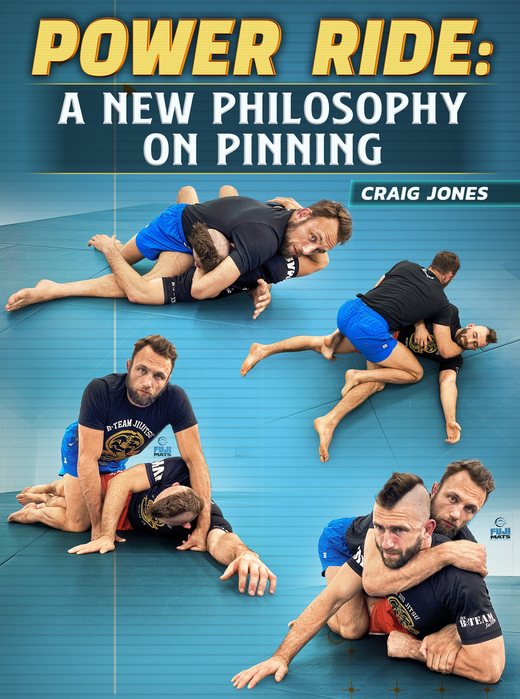
What it covers
Volume 1 is the idea: points don’t mean control, and every escape starts with his feet on the mat. Volume 2 pins the legs (split, ride, Turk, shelf, rear mount), Volume 3 adds the upper body (crossface, claw, open elbow, Dagestani handcuff, half nelson) and Volume 4 rides the turtle (kosoto hook, cradle, diagonal ride, crab hook, spiral ride, underclaw). Volume 5 shows how to get there from side control, mount, knee ride, the back, the leg drag and the body lock. Volume 6 finishes: arm triangle, rear Ezekiel, belly-down rear naked, D’Arce, cow catcher, kimura, gift wrap.
Why it stands out
- Wrestling rides moved into jiu-jitsu: the Turk, the shelf, the claw and the spiral ride, with submissions at the end
- Details you can test in your next roll: hook the Achilles for the Turk, cross your feet on the shelf, heel over his foot on the turtle
- A whole volume on riding the turtle
- Almost all of the 4 hours is teaching: no filler volume
The pins worked for me on day one, against big, explosive people too.
Max, in our full review
It starts once you’re on top: no takedowns, no passing system (Volume 5 assumes you get past the legs) and no live rounds. Most of these positions score nothing under IBJJF points, and Volume 3, the upper body tools, needed a rewatch.
You play top in no-gi, sub-only or MMA and people keep escaping your side control and mount, or you get tired holding big, explosive people down.
Your passing doesn’t get you past the legs yet, or you compete mostly under IBJJF points.
The Anti-Wrestling Equation (#1) to put him back on the mat first, or Hudson Taylor (#4) for folkstyle mat wrestling from both sides.
The Grappling Continuum: Wrestling Techniques, Jiu Jitsu Purpose
Shawn WilliamsRenzo Gracie black belt Shawn Williams teaches it with Zack Esposito and Warren Stout: wrestling from the ground up, from stance and hand fighting to the shots, with two chapters on finishing a shot without giving up the guillotine.

What it covers
Volume 1 is stance, points of contact and movement, including against a seated guard. Volume 2 is hand fighting: clearing the elbow and the inside tie, 2-on-1 and double wrist grips, collar ties. Volume 3 wrestles from butterfly guard (head snaps, arm drag, ankle pick) and clears collar ties three ways. Volume 4 turns the 2-on-1 into takedowns, side control, a turtle breakdown and a tripod sweep. Volumes 5 and 6 are the shots: double and single leg setups, when to shoot to the knees, finishing without giving up the guillotine, the head-inside single, a reverse tai otoshi, snap downs and turtle breakdowns.
Why it stands out
- Built for jiu-jitsu: two chapters on finishing a shot without handing over a guillotine (Volume 5)
- A full volume of hand fighting before the first shot
- Wrestling from butterfly guard too, not only standing (Volume 3)
- Takedowns that end in jiu-jitsu positions: side control, a guard pass, mount or the back
At $147 it’s the priciest takedown course here, and the product page calls it Part 1, “Fundamental Tie Ups & Finishing Strong”: fundamentals, not the whole system. Go by the six-volume chapter list on that page; the description under it lists a different, five-part course. For the double and the single alone, J’Den Cox (#7) is $37.
No-gi players with no wrestling background who want to learn to shoot from scratch, step by step.
You want the scramble after the shot (the turtle, the front headlock, the back): that’s #1. Or you train in the gi: that’s Adam Wheeler (#5).
The Anti-Wrestling Equation (#1) for when he sprawls and turtles, or Hudson Taylor (#4) for the single leg in more depth.
Wrestling For BJJ
Hudson TaylorAn NCAA Division I All-American who won the IBJJF Worlds at blue belt, in the gi, six months after his first class. Half of it is mat wrestling: riding and turning people from the top, then getting out from the bottom. The other half is the single leg, and how to stop one.

What it covers
Volume 1 is top: single wrist control into tilts, the cradle, the power half and his “moneymaker” turn. Volume 2 is bottom: knee slides, the wrist reversal, Granby rolls and sit-outs, and how to stop the power half and the banana split. Volume 3 is hand fighting from the underhook, the 2-on-1 and the ties, then the single leg: running the pipe and eight ways to finish it, standing and on the knees. Volume 4 defends all of it: the ties and the single leg.
Why it stands out
- Mat wrestling from both sides: rides and turns on top (Volume 1), escapes from the bottom (Volume 2)
- Eight ways to finish the single leg, standing and on the knees
- A full volume of takedown defense
- Slow, grinding top control: “speed is the enemy of pinning”, as Taylor puts it on the BJJ Fanatics page
It’s folkstyle: the rides and turns are made to put shoulders on the mat for points, not to set up chokes, so the finishes are up to you. Power Ride (#2) takes the same kind of rides all the way to the submission.
Grapplers who end up wrestling on the mat (turtles, scrambles, someone on all fours) and anyone who wants one solid single leg.
You pull guard and never fight for top. Most of it is about winning and keeping top position.
Power Ride (#2) to finish from the rides, or Chael Sonnen (#11) for leg rides and drills.
Effective Wrestling For Gi Jiu-Jitsu
Adam WheelerA 2008 Olympic Greco-Roman bronze medalist and BJJ black belt teaches the only gi course on this list: ankle picks and doubles with gi grips, spiral rides to chokes, and his own Wheeler-Tine guillotine.

What it covers
Volume 1 is five gi takedowns: the ankle pick, two double leg finishes (break the glass, trip), the 2-on-1 and a duck under to a lift. Volume 2 is where the Greco background shows: front-side offense (cow catcher to side control, 3/4 nelson, nearside cradle) and a spiral ride on the turtle with four finishes: California choke, bow and arrow choke, banana split and neck crank. Volume 3 wrestles from the bottom (sleeve drags, a lapel single leg sweep, toreando defense) and passes from the top (double leg pass, triangle pass), ending with the Wheeler-Tine.
Why it stands out
- Built for the gi: lapel and sleeve grips, and a lapel single leg sweep
- A spiral ride on the turtle with four finishes
- Olympic Greco-Roman medalist and BJJ black belt
- The Wheeler-Tine, his own guillotine
Short: about an hour and a half, with five takedowns in Volume 1. Greco-Roman is upper-body wrestling, so the single and the double get less time than with Hudson Taylor (#4) or Pixley (#6).
Gi players who want takedowns that work with lapel and sleeve grips, plus a turtle attack that ends in a choke.
You train mostly no-gi. Williams (#3) or Taylor (#4) fit better.
Shawn Williams (#3) for more hand fighting, or J’Den Cox (#7) for cheap shot mechanics.
Closing The Gap
Michael Pixley & Heath PedigoNCAA and NAIA national champion Michael Pixley, who also holds IBJJF no-gi world titles, builds a takedown game in belt order, white to black, with Heath Pedigo and the Daisy Fresh team as partners. He beat Nicholas Meregali at ADCC 2024. Our full review →

What it covers
Volume 1 (white belt): stance, thumb block drills, snapdowns, the 2-on-1 to a short drag, the Russian tie, an inside thigh ankle pick, the underhook throw-by, the knee tap and three single leg finishes. Volume 2 (blue belt): stopping the single and the double, sitting down the 2-on-1, beating the underhook, slide-bys and an overtie foot sweep. Volume 3 (purple and brown): from the front headlock to the back, near-side and back-leg cradles, the football grip, fakes into the front headlock, and his favourite takedown from college, a fake high crotch into a low single. Volume 4 is the black belt level.
Why it stands out
- Organized by belt, so you start where you are and grow into the rest
- Defense too: stopping the single and the double (Volume 2)
- From the front headlock to the back, and cradles (Volume 3)
- His partners are Daisy Fresh competitors, and he fixes their mistakes as they go
A lot of the good stuff sits in Volumes 2 and 3, so a beginner pays $98.50 for brown and black belt material they won’t use for a while. If you only want the shots, J’Den Cox (#7) is $37.
Grapplers who want one takedown game that grows with them, from a white belt snap down to brown belt fakes and cradles.
You want a short course on one or two shots. Cox (#7) is shorter and cheaper.
Shawn Williams (#3) for hand fighting and wrestling from guard, or Hudson Taylor (#4) for mat wrestling after the takedown.
Dynamic Wrestling Takedowns For BJJ
J’Den CoxA 2018 world champion, Olympic bronze medalist and three-time NCAA champion teaches the double leg, the single leg, an arm drag series, a standing bicep slicer and “The Claw” in 46 minutes. For $37.

What it covers
Seven chapters: lines of defense, the double leg, clearing the wrist into a single leg (with misdirection), finishing the single, an arm drag series to finishes, a bicep slicer series off the collar tie, and “The Claw”, a wrestling-inspired submission from the seatbelt. He also turns the plain collar tie into a grip he can score from.
Why it stands out
- $37 for world-champion teaching: the cheapest course here by far
- Takedowns finished safely for jiu-jitsu, in good positions
- Two submissions from wrestling you won’t see elsewhere: the standing bicep slicer and The Claw
- The most decorated wrestler on this list
46 minutes, one volume: the shots and a few tricks, nothing on the mat. For mat wrestling, Hudson Taylor (#4) or Chael Sonnen (#11).
Beginners who want a double and a single that are safe in jiu-jitsu, without spending much.
You already have a solid double and single. This is the basics, not chains.
Hudson Taylor (#4) for what happens after the takedown, or Shawn Williams (#3) when you want the full course.
Wrestling For BJJ
Jeff GloverADCC medalist and No-Gi world champion Jeff Glover teaches wrestling the way a jiu-jitsu player uses it: the single leg from the feet, from under mount, from side control, from reverse half guard and from open guard, plus a single that turns into a leg lock.

What it covers
Volume 1 is the feet: concepts, dropping the knee, laying the pipe and an arm drag to the single. Volume 2 is the single leg from the bottom: from under mount, from side control and from reverse half guard. Volume 3 is open guard and butterfly: a single off the knee slice, the arm drag, the “Iranian”, and a single into ashi garami when he defends.
Why it stands out
- Taught by a jiu-jitsu player, for jiu-jitsu players
- Wrestle-ups from bad spots: under mount, side control, reverse half guard
- A single leg that turns into ashi garami and a leg lock when he defends
- One takedown, the single leg, from many places
It’s built around one takedown. For a full standing game, Shawn Williams (#3) teaches more for $50 more, and for pure takedown technique the wrestlers on this list go deeper.
Guard players who want to come up on a single leg without giving up their bottom game.
You want classic wrestling from a wrestler. This is a jiu-jitsu player’s take.
J’Den Cox (#7) for shot mechanics, or Vlad Koulikov (#9) for more submissions off wrestling.
Wrestling For BJJ
Vlad KoulikovVlad Koulikov mixes wrestling, sambo and jiu-jitsu. Most of it happens on the mat: cradles, rides and his “Vladle” into D’Arces, calf slicers and knee bars, plus counters to the single leg and the front headlock.

What it covers
Part 1: the Vladle into a D’Arce, a calf slicer or side control; near-side, far-side and banana split cradles into arm locks, a crucifix and knee bars; the 3/4 nelson, a spiral ride into the back, and his Impaler. Part 2: front headlock escapes, the Peruvian nelson, the Zangief roll, a sumi gaeshi into a D’Arce, counters to the single leg (rolling omoplata, jumping triangle), a duck under into a rolling leg drag or a 50/50 heel hook, and a leg weave to the cow catcher.
Why it stands out
- Wrestling turned into submissions: nearly every cradle and ride ends in a lock or a choke
- Counters to the single leg that only work in jiu-jitsu: the rolling omoplata and the jumping triangle
- Moves you won’t see elsewhere: the Vladle, the Impaler, the Zangief roll
A long list of moves (33 chapters in two parts) more than one system you can follow, and little standing wrestling. For the shots, Williams (#3) or Cox (#7).
Experienced grapplers who like catch-style rides and want a lock or a choke at the end of every one.
You want a structured, beginner-friendly course. Williams (#3) or Cox (#7) are better starting points.
Shawn Williams (#3) for the basics, or Jeff Glover (#8) for more wrestle-ups.
Precision Wrestling For Jiu Jitsu
Shawn MelansonShawn Melanson builds his takedowns from the ties: the collar tie, the over-under, the Russian tie and the rear body lock, each with its own throws, trips and singles, plus counters when they guillotine your shot.

What it covers
Volume 1: the collar tie and hand ties, into an inside tie double leg, a front leg single, running the pipe, a shoulder-high single and a body lock hip toss. Volume 2: the over-under, with a throw-by, crotch lift, lat drop, hip toss, kick throws, a duck under into a double and harai goshi. Volume 3: the collar tie and the Russian tie into a slide-by, a body lock, a key lock, an outside single and a high crotch. Volume 4: rear body lock lifts and trips, two guillotine counters, a knee pick and “the Metzger”.
Why it stands out
- Organized by tie: pick the grip you get most and learn what comes off it
- Throws you rarely see in wrestling courses for BJJ: the lat drop, kick throws, harai goshi
- What to do when he guillotines your shot (Volume 4)
Mostly upper-body: the single and the double get less time than with Hudson Taylor (#4) or Pixley (#6). It’s also the newest course here (May 2025), so there is little to go on beyond the chapter list.
No-gi players who end up in the clinch a lot and want throws and trips from the ties they already get.
You’re new to wrestling. Start with Cox (#7) or Williams (#3).
Hudson Taylor (#4) for the single leg, or Jeff Glover (#8) for wrestling up from guard.
Wrestling Fundamentals From The Bad Guy
Chael SonnenAll-American wrestler at Oregon, Olympic alternate in Greco-Roman and UFC title challenger Chael Sonnen teaches straight wrestling fundamentals: chain wrestling off the ties, leg rides, bottom wrestling and a full volume of drills, with NAIA champion Austin Vanderford as his partner. Our full review →

What it covers
Volume 1 is chain wrestling off the collar tie and the 2-on-1, three chapters of front headlocks, arm drags, underhooks and low singles. Volume 2 is leg riding (entries, home base, troubleshooting), mat returns and a far-side cradle. Volume 3 is the bottom: counters from referee’s position, clearing the legs, chain wrestling from the bottom, low leg and front headlock defense. Volume 4 is warm-ups and drills: flow wrestling, the rule of 10, pummeling, balance, wall and throw drills.
Why it stands out
- Chain wrestling: every tie leads to the next attack
- A volume of leg riding, a wrestler’s way to break down the turtle
- A full volume of partner and wall drills you can run anywhere
It’s straight wrestling: no jiu-jitsu rule changes, nothing on the guillotine when you shoot, and front headlocks without the chokes. For wrestling made for jiu-jitsu, start with #1 or #3.
Grapplers who want real wrestling basics and drills from a wrestler, especially the leg rides.
You want wrestling built for jiu-jitsu. Craig (#1) and Williams (#3) adapt it; Sonnen doesn’t.
Hudson Taylor (#4) for more mat wrestling, or J’Den Cox (#7) for the shots.
All picks, side by side
Comparison tableSwipe sideways for details · the price column stays pinned →
| # | Instructional | Runtime | Level | Format | Best for | Price | Buy |
|---|---|---|---|---|---|---|---|
| 1 | The Anti-Wrestling EquationCraig Jones | 7h 00m | Blue belt and up | No-Gi | Turtle, stand-ups, the back | $98.50list $197 | Check price → |
| 2 | Power RideCraig Jones | 4h 09m | Blue belt and up | No-Gi | Holding people down | $197 | Check price → |
| 3 | The Grappling ContinuumShawn Williams | 3h 19m | All levels | No-Gi | Learning takedowns | $147 | Check price → |
| 4 | Wrestling For BJJHudson Taylor | 3h 00m | All levels | No-Gi | Mat wrestling | $79list $167 | Check price → |
| 5 | Effective Wrestling For Gi Jiu-JitsuAdam Wheeler | 1h 28m | All levels | Gi | Gi | $79 | Check price → |
| 6 | Closing The GapMichael Pixley & Heath Pedigo | 1h 30m+ | All levels | No-Gi | Takedowns by belt | $98.50 | Check price → |
| 7 | Dynamic Wrestling Takedowns For BJJJ’Den Cox | 46 min | Beginners to intermediate | No-Gi | Cheap start | $37 | Check price → |
| 8 | Wrestling For BJJJeff Glover | 1h 25m | Intermediate to advanced | No-Gi | Wrestle-ups | $97 | Check price → |
| 9 | Wrestling For BJJVlad Koulikov | 2 vol. | Intermediate to advanced | No-Gi | Submissions off wrestling | $79 | Check price → |
| 10 | Precision Wrestling For Jiu JitsuShawn Melanson | 1h 38m | Intermediate to advanced | No-Gi | Ties and throws | $79 | Check price → |
| 11 | Wrestling Fundamentals From The Bad GuyChael Sonnen | 2h 30m | All levels | No-Gi | Chain wrestling, drills | $79$97 with DVD | Check price → |
Find your wrestling instructional
Start with what goes wrong for you on the mat.
Pricing & deals
The prices in the table are the public BJJ Fanatics prices on 3 November 2026, before any checkout code. Two were on sale that day: The Anti-Wrestling Equation at $98.50 (list $197) and Hudson Taylor’s course at $79 (list $167). Sonnen’s $79 is the digital version; with the DVD it’s $97. The cheapest course here is J’Den Cox’s at $37.
Want to try wrestling material before buying? Start with the wrestling, judo and striking options in our free cross-training roundup.
More on this: the best takedown instructionals, instructionals to beat wrestlers and every Craig Jones instructional, ranked.
FAQ
What is the best wrestling instructional for BJJ?
Craig Jones’ The Anti-Wrestling Equation, because it teaches the wrestling you actually run into in jiu-jitsu: the front headlock, the turtle, people standing back up, the rear body lock and the back. Of everything I’ve watched for standup, it helped mine the most. It has no shots, though: to learn takedowns from scratch, start with Shawn Williams’ The Grappling Continuum (#3).
Which should I buy first, The Anti-Wrestling Equation or Power Ride?
It depends on where people get away from you. If they turtle, post on their hands and stand up, The Anti-Wrestling Equation. If they escape once you’re on top, Power Ride. They fit together: the first puts him back on the mat, the second keeps him there.
What are the best wrestling instructionals for BJJ beginners?
J’Den Cox’s Dynamic Wrestling Takedowns ($37, 46 minutes) is the cheapest way to learn a double and a single that are safe in jiu-jitsu. For a full course from stance and hand fighting up, Shawn Williams’ The Grappling Continuum ($147). In the gi, Adam Wheeler. Craig’s two courses pay off more once you’re past white belt.
Is there a wrestling instructional for gi BJJ?
Yes: Adam Wheeler’s Effective Wrestling For Gi Jiu-Jitsu ($79), the only gi course on this list. Wheeler is a 2008 Olympic Greco-Roman bronze medalist and a BJJ black belt, and his takedowns use gi grips: the ankle pick, two doubles, a lapel single leg sweep, plus spiral rides on the turtle that end in chokes.
Do I need wrestling for BJJ if my gym rarely trains standup?
Yes. Even if your gym pulls guard, competitions start standing and you lose points or position every time you concede a takedown. And most of the wrestling you’ll use happens on the mat anyway: scrambles, the turtle, people standing back up, holding someone down. That’s what #1 and #2 teach.
What is the cheapest wrestling instructional for BJJ?
J’Den Cox’s Dynamic Wrestling Takedowns For BJJ: $37 on 3 November 2026. Seven chapters: lines of defense, the double leg, clearing the wrist into a single, finishing the single, an arm drag series, a bicep slicer series and The Claw.
Which wrestling instructional is best for breaking down the turtle?
Power Ride: Volume 4 is all turtle rides (kosoto hook, cradle, diagonal ride, crab hook, spiral ride, underclaw), and the rides lead to finishes. The Anti-Wrestling Equation attacks the turtle from the front: the neck when he’s on his hands, the go-behind when he’s on his elbows. For folkstyle rides, Hudson Taylor (Volume 1) and Chael Sonnen’s leg riding (Volume 2).
Which of these teach you to stop takedowns?
Hudson Taylor gives it a full volume: defending the ties and the single leg, standing and on the knees. Pixley’s Volume 2 stops the single and the double, Sonnen’s Volume 3 covers front headlock and low leg defense, and Koulikov counters the single leg with a rolling omoplata and a jumping triangle. The Anti-Wrestling Equation is the counter-wrestling pick: most of it starts from his reaction, not your speed.
Start with the problem you have most.
People turtle and stand up on you: The Anti-Wrestling Equation. They escape once you’re on top: Power Ride. You want to learn to shoot: The Grappling Continuum. Check the current price on the product page before you buy.