I Ranked 10 Half Guard Instructionals: Here’s the One I’d Buy First
The 10 half guard instructionals worth buying, ranked by what they teach, who they suit and what they cost. The one I’d buy first is #1, and if you’re the one on top in half guard, the two sets for that come right after the ranking.
Heads up: the BJJ Fanatics links below are affiliate links. If you buy through them I earn a commission at no extra cost to you. It never changes the rankings: every pick is judged on what it teaches you, who it suits, and what you pay for what you get.
Half guard used to be a stalling position. Now it’s one of the most offensively dangerous places in jiu-jitsu, with entire systems built around the knee shield, dogfight, deep half, and coyote guard. I’ve analyzed and compared every major half guard instructional on BJJ Fanatics and ranked the 10 best by what they teach, who they suit and what they cost.
The short version: if your half guard keeps getting passed, start with Craig Jones’ Make Z Guard Great Again (#1). If half guard is already your main guard, Lachlan Giles’ Half Guard Anthology (#2) covers nearly every version of it for $79. On top of half guard instead? Jump to the two sets for the top player ↓
List prices checked 3 November 2026. Sales and codes often take them lower, so check today’s price before you buy.
№1 · The one I’d buy first: knee shield / Z guard
1
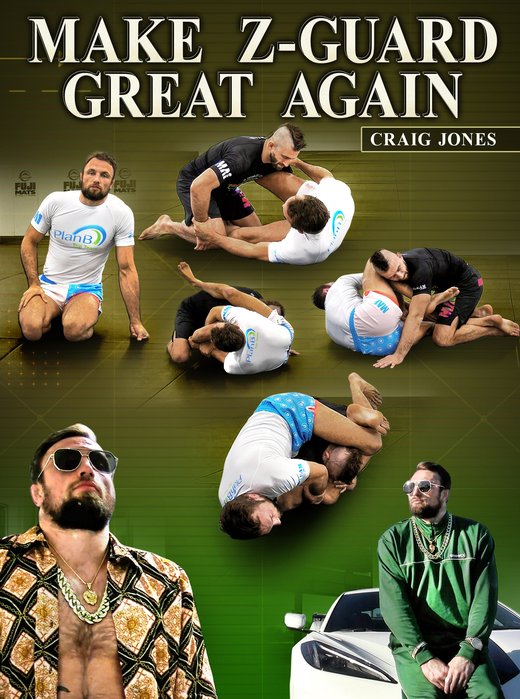
Make Z Guard Great Again
Craig Jones
If your half guard keeps getting passed, start here. Craig Jones builds one knee shield system that holds the position and attacks from it: the frame, the passes people use against it and the counter to each, then the kimura, armbar, triangles, choi bar and leg entries.
He falls into the triangleFall back under his pressure: he drops forward into the triangle, and it locks. Vol 4 · 43:59Our full review →
Volume 1 builds the frame. Volume 2 shows six passes people use against the knee shield, including the weave and Kit Dale’s pass, and the counter to each one. Volumes 3 and 4 attack the arm: the kimura, the armbar, triangles, the choi bar and the omoplata. Volume 5 goes to the legs, and Volume 6 turns the knee shield into underhook half guard when the top player gets past the frame. There are no live rounds: every minute is Craig and his partner demonstrating.
It keeps the position first: Craig treats the knee shield as a way to hold half guard, then attacks from it.
Volume 2 shows the passes people use on your knee shield, then the counter to each, so you know what’s coming.
The choi bar from Volume 4 finished Joao Costa 16 seconds into their ADCC 2022 match.
About 5 hours of almost nonstop teaching, and Craig’s humor keeps dense material easy to watch.
The honest weakness
There are no live rounds, so the course never shows the system against someone resisting (Craig’s own matches are the proof). It is one family, the knee shield, plus underhook half guard in Volume 6: for deep half, add Bernardo Faria’s Battle Tested (#5). It is filmed in no-gi, and at $197 list it costs more than the $79 Anthology.
The verdict
Best for
Anyone whose half guard keeps getting passed and who wants one system that holds it and attacks from it. Blue belt and up.
Avoid if
you need live rounds to learn (there are none), or half guard is already your main guard and you want every version of it: the Anthology (#2) covers more for $79.
Pairs with
Lachlan Giles’ Half Guard Anthology (#2) covers the half guard families Craig doesn’t touch, and Lucas Leite’s Coyote Half Guard (#4) adds the gi dogfight game.
The most complete half guard course you can buy. Giles covers nearly every half guard family (knee shield, underhook, dogfight, reverse half, reverse De La Riva, sit-up guard, shin-to-shin) with a troubleshooting chapter for most of them. If half guard is your main guard, this is the one.
Volume by volume: The publisher lists eight volumes. Volume 1 covers entries; volume 2 covers recovery when half guard is compromised, including crossface/underhook problems, switch base and Three Quarter Mount. Volume 3 develops knee shield, underhook and overhead attacks including modified X, while volume 4 develops underhook half guard. Volume 5 adds kneecut-underhook, reverse-half and dogfight material. Volumes 6-7 move into sit-up/shin-to-shin and reverse De La Riva respectively. Volume 8 explicitly combines Z guard, kimura and narrated rolling. Start with volume 2 if you keep losing the position, volume 3 for your knee shield, or volume 8 for the listed Z-guard/kimura material.
Why it stands out
A troubleshooting chapter for most positions (knee shield, underhook, dogfight, sit-up guard, reverse De La Riva, waiter) tells you what to do when your attack gets shut down
Covers transitions between half guard families, so you know when to switch from knee shield to underhook to dogfight based on your opponent’s reactions
Volume 8 combines Z guard and kimura material with narrated rolling
$79 list, less than half of Craig’s or Danaher’s $197
The honest weakness
It trades depth for breadth in places. Lachlan says he’s not a huge fan of deep half in no-gi, and the lockdown isn’t in it: for deep half, Bernardo Faria’s Battle Tested (#5) is more focused, and for the knee shield, Make Z Guard Great Again (#1) goes deeper. At about 11 hours, it is also a lot to get through.
The verdict
Best for
Anyone who plays half guard as their main guard and wants every version of it from one teacher. Ideal for intermediate grapplers filling gaps in their game.
Avoid if
you already have a complete half guard game and only need specialist-level depth on one specific position.
Pairs with
Craig Jones’ Make Z Guard Great Again (#1) for deeper knee shield work, or Bernardo Faria’s Battle Tested (#5) for deep half
About 8 hours of Danaher’s conceptual teaching on bottom half guard, in the gi. The paradox of half guard, the tight-waist trilemma and five chapters on the whizzer fight give you the why behind every sweep.
Runtime~8 hours across 8 volumes
Released2019
LevelWhite belt through black belt
FormatGi (concepts carry over to no-gi, except the Vol. 7 lapel work)
Volume by volume: Volume 1 introduces the course. Volume 2 contains the Paradox, alignment and kuzushi material; volume 3 develops elbow escapes, sumi gaeshi and half-butterfly transitions. Volume 4 develops underhooks and the Trilemma. Volume 5 includes rules and the Limp Arm, while volume 6 develops the numbered tight-waist-versus-whizzer situations, foot fighting and takedowns. Volume 7 lists lapel-single-leg sections alongside posture considerations for half-guard sweeps. Volume 8 lists the Knee Lever Series, Back Roll Sweep and the problem of reverse half guards. Start with volume 4 for your underhook, volume 6 when the whizzer stops you, or volume 8 for the knee-lever route.
Why it stands out
The “Paradox of the Half Guard” reframes how you think about the position strategically, not just technically
Five chapters on the tight waist against the whizzer (Vol. 6) take on the top player’s best answer to your underhook
The trilemma gives you clear “if he does X, you do Y” choices instead of loose techniques
The knee lever series in Vol. 8 adds leverage attacks most people haven’t felt before
The honest weakness
The teaching is slow and repeats itself a lot, even by Danaher’s standards. At $197 list it costs about 2.5 times the $79 Anthology, which covers more positions. Volume 7 has lapel single-leg work you won’t use in no-gi. If you want more moves per hour, Craig Jones (#1) or Lucas Leite (#4) deliver them.
The verdict
Best for
Practitioners who want to understand why half guard works, not just what to do. Long-term students willing to study systematically over weeks.
Avoid if
you prefer concise, technique-focused instruction, or you primarily train no-gi and don’t want to pay for a gi-heavy lapel volume.
The underhook half guard and dogfight system of Lucas Leite, who weighs about 165 lbs and picks opponents 30-40 lbs heavier on purpose. Simple leverage sweeps, led by the “Carry the Baby”, built for people bigger than you.
Volume 1 is the underhook and the dogfight: the back take, the dogfight sweeps including Carry the Baby, the rubber arm back take when he whizzers, and stopping the knee slice and the back step. Volume 2 gets you to the Coyote from bad spots (shoulder pressure, bottom side control) and adds lasso, X guard and back roll sweeps. Volume 3 is passing-to-the-back drills and back control. Volume 4 adds a D’Arce defense, the “wiggle wiggle”, the 2-on-1 entry to the Coyote and leg attacks from X guard (knee bar, calf crank).
Why it stands out
The Carry the Baby sweep is quick to learn and works on bigger people because it uses leverage, not strength
Two clear routes into the same position: the underhook to the dogfight, or the 2-on-1 to the Coyote
Answers to the top player’s best counters: stopping the knee slice and the back step (Volume 1) and a D’Arce defense (Volume 4)
Every sweep has a back take attached, so a half-stopped sweep still goes somewhere
The honest weakness
It is short next to the Anthology (about 11 hours) and focused on one game: no knee shield system and little deep half beyond the entry into the Coyote. It is filmed in the gi, with lasso and sleeve grips, so no-gi players lose part of it.
The verdict
Best for
Smaller practitioners who need leverage-based sweeps against bigger training partners. Dogfight enthusiasts. Anyone wanting a simple, proven system to build their half guard around.
Avoid if
you need comprehensive half guard coverage (Z guard, deep half, etc. are missing). Giles’ Anthology covers more positions for the same price.
Pairs with
Craig Jones’ Make Z Guard Great Again adds the knee shield game Leite doesn’t cover. Bernardo Faria’s Battle Tested adds deep half.
5x black belt world champion Bernardo Faria’s half guard runs on two positions: single-leg half and deep half, with constant switching between them. It is simple, it is in the gi, and it is the game he is known for.
DVD 1 covers guard entries, the single-leg half guard concept (Faria’s signature innovation), single-leg half sweeps, counter passes, and sweep finishing options. DVD 2 addresses reverse half guard, deep half guard sweeps, grip fighting for deep half, and transitions between single-leg half and deep half. DVD 3 features the “Turkish Get Up” technique combining deep half, single-leg half, and lapel sweeps, plus defenses against kimura, guillotine, and choke attacks from half guard, and omoplata setups. DVD 4 is four rolls, against Fernando Reis, Michael Zenga, Marc Berman and Kyle Misuraca.
Why it stands out
Faria is a 5x black belt world champion, and his opponents knew the half guard was coming
Simple enough for beginners, with sweeps you can try in your next round
Four rolls on DVD 4 show the system against training partners
The single-leg half guard gives you a sweep path opponents rarely see
A clear two-position system (single-leg half + deep half) is easy to study and drill compared to encyclopedic sets
The honest weakness
At about 3 hours it is much shorter than the Anthology (about 11) or Danaher (about 8). It is filmed in the gi, with lapel sweeps. It doesn’t cover the knee shield, the lockdown or half butterfly, and it shows what to do more than why. No troubleshooting chapters like the Anthology’s.
The verdict
Best for
Competitors who want proven World Championship techniques. Beginners who want immediately applicable sweeps. Deep half guard specialists.
Avoid if
you train primarily no-gi, or you want a comprehensive system covering most half guard families. Giles’ Anthology offers much more breadth at the same price point.
Pairs with
Lachlan Giles’ Half Guard Anthology fills in the Z guard, underhook, and RDLR positions Faria doesn’t cover
A Canadian who won his titles in Brazil from half guard. Jake Mackenzie’s reverse half guard was new even to Bernardo Faria, and this set pairs it with his deep half and waiter sweeps, in the gi.
Part 1 is deep half: the entry, three rewinds (knee twist, electric chair, refs position), the double leg and the Houdini back take, plus sleeve-grip sweeps. Part 2 is back takes from deep half and the waiter sweep, including the crotch lock back take and the dreidel. Part 3 is reverse half guard: the basics, the elevator sweep, the reverse electric chair and the Lins back take. Part 4 adds the pitel, rocket and far hook sweeps, and counters to the leg triangle and the knee bar.
Why it stands out
A full part on reverse half guard, with sweeps and back takes from it
Deep half with three different rewinds, so you have a plan when the first sweep fails
Back takes from everywhere: deep half, the waiter and reverse half
Part 4 has answers for when he goes after your legs: counters to the leg triangle and the knee bar
Jake Mackenzie is among the foremost experts in the world on the use of the half guard.
Ryan Hall, on the BJJ Fanatics product page
The honest weakness
It is built on gi grips (sleeves), so a lot of it doesn’t carry over to no-gi. There is no knee shield or underhook system: the Anthology (#2) covers far more families for the same $79. No rolls.
The verdict
Best for
Gi players who like deep half and want reverse half guard as a second option opponents rarely see.
Avoid if
you train mainly no-gi (the sleeve grips don’t translate), or you want a complete system covering most half guard families.
Pairs with
Craig Jones’ Make Z Guard Great Again for the knee shield game Mackenzie doesn’t emphasize, or Lachlan Giles’ Anthology for comprehensive coverage
Paul Schreiner, a long-time Marcelo Garcia Academy instructor, teaches half guard as a chain of reactions: what you do when he takes the overhook, when you win the underhook, when he whizzers and when he backsteps.
RuntimeNot listed (4 volumes)
Released2020
LevelIntermediate to advanced (purple belt+ ideal)
Part 1 is defense from the overhook half guard: the John Wayne frames, recovering and sweeping, and breaking his late underhook. Part 2 flips to offense with the underhook: high and elbow-first underhooks, the limp arm, and beating the whizzer (body lock, shin whizzer, whizzer trap roll). Part 3 is the Jedi Mind Trick series to the back and the leg drag, plus the Kaiborg stiff arm. Part 4 adds answers to the backstep, reverse De La Riva half and the Maze guard.
Why it stands out
Teaches the connections between positions rather than isolated techniques, giving you a flowing game
Starts on defense (the overhook half guard), the spot most half guard players actually live in
A full part on the Jedi Mind Trick: forcing it, using it against the backstep and finishing the leg drag from it
Fills the gap between knowing techniques and flowing between them in live rolling
The honest weakness
Not ideal for beginners who need concrete techniques first. It is less encyclopedic than the Anthology, and at $149 list it costs almost twice the $79 Anthology, which also covers the Jedi Mind Trick. If you need one specific answer (e.g., “how do I sweep from deep half?”), Faria’s Battle Tested (#5) gets there faster.
The verdict
Best for
Purple belts and above who already know half guard techniques but need to connect them into a flowing system. Concept-oriented learners who want reaction-based training.
Avoid if
you’re a beginner who needs concrete techniques first. Start with DeBlass or Faria, then come back to Schreiner.
Pairs with
Tom DeBlass’ Half Domination for foundational techniques that Schreiner’s concepts connect
Tom DeBlass teaches half guard with a safety-first philosophy: framing and retention before offense. His approach emphasizes efficiency over athleticism, making this the ideal starting point for beginners and older grapplers who can’t rely on speed or flexibility.
Volume 1 covers bottom half guard fundamentals: knee shield basics, framing philosophy, retention before offense, and butterfly half guard variation. Volume 2 moves to top half guard with guillotines, arm locks, and guard passing options. Volume 3 covers advanced bottom attacks including kimuras, toe holds, the signature “Spartan Push” for leg lock entries, and recovery paths. Volume 4 is the guard retention workshop covering knee slice prevention scenarios and retention drills.
Why it stands out
Volume 4 is a guard retention workshop built around stopping the knee slice
Safety-first approach teaches proper frames and retention before any offensive techniques
Simple, effective techniques without excessive complexity, applicable across body types and ages
Covers both bottom AND top half guard, unlike most sets that only address the bottom game
Spartan Push opens leg lock entries that many opponents won’t anticipate from half guard
The honest weakness
At about 4 hours it has nowhere near the depth of the 11-hour Anthology or Danaher’s 8 hours. Once your frames work you’ll outgrow it, and the Anthology costs the same $79.
The verdict
Best for
Beginners who need a solid half guard foundation built on proper defensive habits. Older or less athletic grapplers who need efficiency-based techniques.
Avoid if
you already have solid half guard fundamentals and want advanced material. Giles’ Anthology ($79) or Danaher’s GFF ($197) go much deeper.
Pairs with
Lachlan Giles’ Anthology (#2) when you’re ready for a complete system
Brian Glick, a John Danaher black belt, teaches half guard the way his coach does: the tight-waist trilemma, the knee lever and the whizzer fight, with troubleshooting for when you get smashed. Eight parts, the last two a study guide that recaps the key techniques.
Part 1 sets up the concepts, three skills (the lower leg shift, the knee lever, shelfing the leg) and the entries from pin escapes and from guard. Parts 2 and 3 are the tight-waist trilemma: the roll-through sweep, hiza gatame, the ankle pick and the duck under, with fixes for the posted arm, the posted leg and the guillotine. Part 4 is the knee lever, Part 5 the side-by-side fight of tight waist against whizzer (limp arm, kosoto, body lock, back take, single legs), and Part 6 troubleshooting when you are smashed flat. Parts 7 and 8 are a study guide.
Why it stands out
Danaher’s half guard system in no-gi, from one of his black belts
A clear problem-and-answer structure: the posted arm, the posted leg, the guillotine, the strong whizzer, the knee cut and the backstep each get a chapter
A troubleshooting part for bad days: the smashed knee shield, flat chest to chest, the sit-out
The study guide (Parts 7 and 8) is a fast way to review before training
The honest weakness
It covers much the same ground as Danaher’s Half Guard GFF (#3): the trilemma, roll-through sweeps, the knee lever and the limp arm, at the same $197. Pick one, not both: Glick for no-gi, Danaher for the gi. Two of the eight parts are a recap, so the new material is shorter than the runtime suggests.
The verdict
Best for
No-gi players who want Danaher’s half guard system without the gi, and like a clear problem-and-answer structure.
Avoid if
you already own Danaher’s Half Guard GFF, or you want breadth: the Anthology (#2) covers more families for $79.
Pairs with
Lachlan Giles’ Half Guard Anthology (#2) when you want more half guard families than the tight-waist game
Gordon Ryan’s bottom half guard for no-gi: butterfly half, knee shield, deep half and the scorpion, with routes to the back and many to the legs. Eight volumes, including his own gym rolls with his commentary, at $349 list.
Part 1 sets up butterfly half and the knee shield, the battle for inside position and the scoop grip into X guard and cross ashi. Part 2 is the pinch headlock and sumi gaeshi, and a kimura series from butterfly half. Part 3 adds the lower leg shift and the roll against the whizzer, Part 4 the knee lever and arm drags, Part 5 deep half and Part 6 the scorpion. Gordon also breaks down his own gym rolls from half guard.
Why it stands out
Gordon’s own no-gi bottom game: butterfly half, knee shield, deep half and the scorpion in one set
Leg entries off almost every sweep (irimi ashi, cross ashi, X guard), so a failed sweep still goes somewhere
Gordon breaks down his own gym rolls from half guard, so you see the system against resistance
Built for no-gi and submission grappling rules
The honest weakness
At $349 list it is the most expensive set here, more than four times the $79 Anthology. Eight volumes with no study plan can feel like drinking from a firehose, and it assumes you already know the legs and the back. For a no-gi knee shield game, Craig Jones’ Make Z Guard Great Again (#1) is more focused at $197.
The verdict
Best for
Dedicated no-gi competitors who want the Gordon Ryan methodology applied to half guard. Practitioners who already own Ryan’s other instructionals and want a complete set.
Avoid if
you’re on a budget (Giles’ Anthology covers more for less), or you want a concise, focused instructional. Ryan’s teaching style requires patience.
Pairs with
Craig Jones’ Make Z Guard Great Again (#1) for a different take on the knee shield, or Gordon’s Half Guard 2.0 (below) for the top side
Everything above is for the person on the bottom. If you’re the one on top, these are the two 2026 sets I’d pick, and we’ve reviewed both in full: Gordon teaches you to pass half guard, Craig teaches you to pin people in it.
To pass it
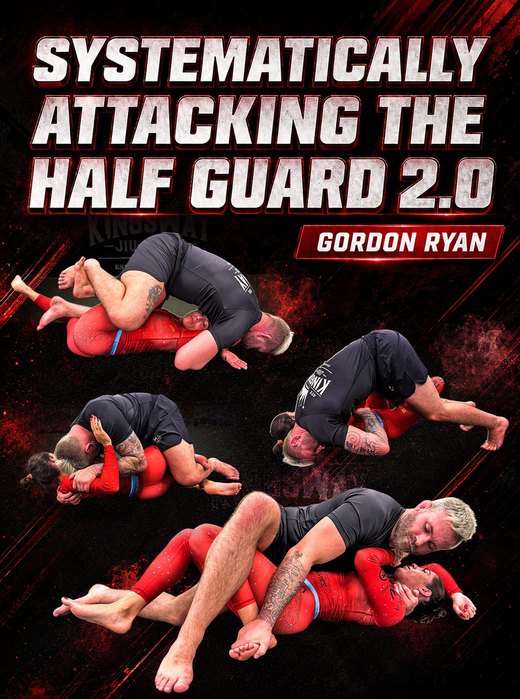
Systematically Attacking The Half Guard 2.0
Gordon Ryan · no-gi · released August 2026
Buy it if you get on top in half guard, try to pass and get rolled over: Gordon shows how to pass without coming up. It is for people who already pass from chest to chest, not a first half guard passing course.
Up high, rolled overWhy 2.0 says stay low: she is up high on her toes, he pushes her hip up and rolls her over his shoulder. Vol 1 · 9:24Our full review →
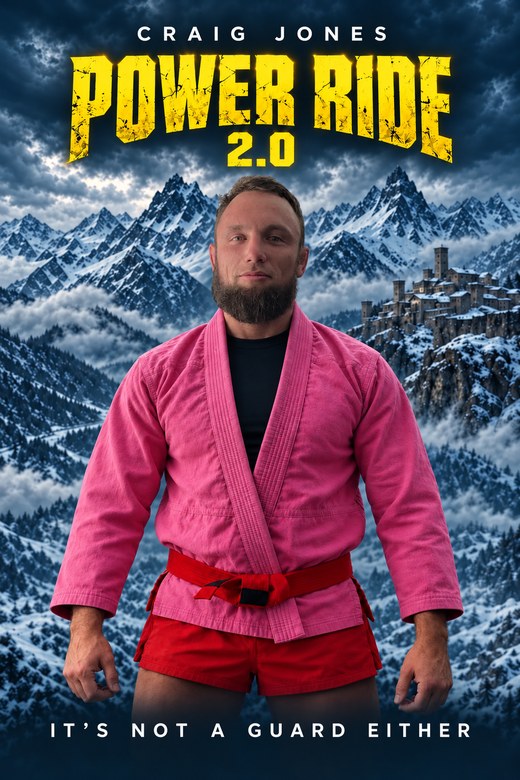
Buy it if you play top and keep landing in half guard: Craig turns top half guard with a near side underhook into a pin, with four finishes that feed into each other. Only about two of its three hours are teaching, so buy it on sale, not at list.
He bridges, Craig ridesThe pin: he bridges hard, Craig rides the hips with his knee and barely moves. Vol 1Our full review →
Three things decide the order: what a set teaches you, who it suits, and what you pay for what you get. Where we’ve reviewed a set in full on this site, that review decides its spot.
Make Z Guard Great Again (#1) is the one I’d buy first. One knee shield system takes you from keeping half guard, through the passes people use against it, to the arm and leg attacks. It is also the one set in this ranking we’ve reviewed in full, with clips.
The Half Guard Anthology (#2) is the most complete: nearly every half guard family from one teacher, with troubleshooting chapters along the way, for $79. If half guard is already your main guard, buy it first.
Danaher’s Half Guard GFF (#3) is the gi pick and the one that explains why things work: about 8 hours on the underhook, the roll-through sweep and the whizzer fight. It is slow and repeats a lot.
The other seven each fit one kind of player: the dogfight (Leite), deep half (Faria), reverse half in the gi (Mackenzie), the overhook and whizzer fight (Schreiner), a gentle first course (DeBlass), Danaher’s system in no-gi (Glick) and Gordon Ryan’s no-gi bottom game.
Which Half Guard Instructional Fits Your Game?
🔬
Which Half Guard Instructional Fits Your Game?
Answer 2-3 quick questions to get a personalized pick
Answer a few questions to find the right half guard instructional for your game.
📚 Complete SystemI want one instructional covering all half guard positions
›
🎯 Specific PositionKnee shield, dogfight, deep half, or reverse half
›
🥋 By Experience LevelBest pick for my belt level
›
🔝 I’m on TopI want to pass half guard or pin people in it
›
What happens when you’re on top?
I try to pass and get rolled over
I keep landing in half guard and want to hold them there
What’s your format preference?
Gi
No-Gi
Both / Don’t care
Which half guard family?
Knee Shield / Z Guard
Dogfight / Underhook
Deep Half
Reverse Half Guard
What’s your experience level?
Beginner (white-blue belt)
Intermediate (blue-purple belt)
Advanced (purple belt+)
Half Guard (GFF) – John Danaher
About 8 hours of conceptual half guard teaching in the gi. The trilemma and the whizzer chapters solve the problems you hit in rolling.📚 Slow and repetitive, but the best pick if you want to know why a sweep works.
About 11 hours, filmed in no-gi: knee shield, underhook, dogfight, reverse half, reverse De La Riva and more, with troubleshooting chapters.🎯 $79 list for the most complete half guard course on this page.
Covers nearly every half guard family in one course, filmed in no-gi. Troubleshooting chapters help you solve specific problems quickly.🎯 The broadest coverage for $79.
If you prefer deep conceptual understanding over technique breadth. The Trilemma and Paradox frameworks change how you think about half guard.📚 More gi-focused; best for long-term systematic study.
One knee shield system: the frame, the counters to six common passes, then the kimura, choi bar, triangles and leg entries.🏆 Our #1 pick. Its Volume 4 choi bar finished Joao Costa in 16 seconds at ADCC 2022.
Underhook half guard built around the dogfight: Carry the Baby, the back take when he whizzers, and stopping the knee slice. Filmed in the gi.🥋 Leite picks opponents 30-40 lbs heavier and still sweeps them.
5x world champion deep half and single-leg half system. Simple sweeps you can try in your next round, filmed in the gi.🏆 Four rolls on DVD 4 show the system live.
A full part on reverse half guard (elevator sweep, reverse electric chair, Lins back take), plus deep half with three rewinds. Filmed in the gi.🔥 Reverse half guard gives you a second option most opponents haven’t seen.
Safety-first approach: framing and retention before offense. Simple, effective techniques without excessive complexity, and Volume 4 is a guard retention workshop.💰 $79 list for a solid foundation.
Simple sweeps from single-leg half and deep half that you can hit this week. Four rolls on DVD 4 show how they work live.🏆 5x world champion techniques that work for all body types.
Fill gaps across nearly every half guard family. Troubleshooting sections tell you exactly what to do when your standard attacks get shut down.🎯 Best for understanding which half guard variation to use when.
One knee shield system with elite details: kimura to choi bar chains, triangles and leg entries, plus the counters to the passes people use on you.🏆 Its Volume 4 choi bar finished an ADCC 2022 match in 16 seconds.
Concepts-heavy instructional that teaches the chain reactions between half guard positions. If you already know techniques but need to connect them into a flowing system.📚 Best for purple belts and above who want systems over techniques.
Systematically Attacking The Half Guard 2.0 – Gordon Ryan
Stay low and pass without coming up into the high tripod, so she can’t post on your hip and roll you over.📚 For people who already pass chest to chest. Not a first half guard passing course.
Half guard as a pin: top half guard with a near side underhook, and four finishes that feed into each other.💰 About two hours of teaching, so buy it on sale.
List prices on BJJ Fanatics, checked 3 November 2026, before sales, codes or taxes. Sales are frequent (that day five of the ten were half price), so confirm the final amount before paying.
Choose by budget and position: Five of the ten cost $79 at list: Giles (broad coverage), Leite (dogfight), Faria (deep half), Mackenzie (reverse half) and DeBlass (a gentle start). Schreiner is $149; Craig, Danaher and Glick are $197; Gordon is $349. My first pick, Craig’s Make Z Guard Great Again, costs more than the Anthology: pay the difference if your half guard keeps getting passed and you want one system to build on.
Check the option: Craig and Glick sell a single course option, not one named Digital, and so do Gordon’s Half Guard 2.0 and Power Ride 2.0. Faria is $79 Digital Video, with the notes option also at $79. Mackenzie is $79 Digital or $107 for the DVD+Digital combo. The table uses each main option and assumes no coupon.
Half Guard Glossary
Knee Shield (Z Guard): A half guard variation where you place your shin across your opponent’s torso, creating distance and framing. The go-to defensive half guard position for creating space and attacking.
Dogfight: A neutral position where both players are on their knees, competing for underhooks and head position. Half guard players reach the dogfight through underhook half guard and use it as a sweep launching point.Face push from the dogfightThe dogfight in Make Z Guard Great Again: bring the underhook hand up to his face, and it opens his whizzer arm. Vol 6 · 25:16Our full review →
Deep Half Guard: A variation where you scoot your body underneath your opponent, controlling their far leg. Used for sweeps against larger or heavier opponents who flatten you in standard half guard.
Coyote Guard: Lucas Leite’s underhook-based half guard system built around unique leg-trapping mechanics and the dogfight position.
Reverse Half Guard: A half guard variation where you face away from your opponent’s upper body. Jake Mackenzie’s primary system, offering unusual sweep angles opponents rarely train against.
Half Butterfly: A hybrid position combining one butterfly hook with half guard leg entanglement. Prevents smash passing and creates natural entries to leg locks and X-guard.
Lockdown: A half guard control popularized by 10th Planet, where you use a figure-four lock on the trapped leg to freeze your opponent’s movement. Creates sweep opportunities through the “Electric Chair” and “Whip-Up.”
Underhook: Reaching under your opponent’s far armpit from bottom half guard. Considered the most important grip battle in half guard because it enables the dogfight, back takes, and most major sweeps.
Whizzer (Overhook): The top player’s counter to the bottom player’s underhook. An overhook on the bottom player’s reaching arm. Danaher spends five chapters of Volume 6 on the tight waist against the whizzer.
Knee Lever: A Danaher concept using leverage against the trapped leg to create sweep opportunities. Featured in Volume 8 of his Half Guard GFF.
Single-Leg Half: Bernardo Faria’s signature concept where you treat your half guard position as a single-leg takedown setup, using the trapped leg as your anchor for sweep attempts.
Choi Bar: An armlock from the knee shield where your leg comes over his arm. Craig Jones’ Volume 4 version in Make Z Guard Great Again finished Joao Costa 16 seconds into their ADCC 2022 match.
Ageless Jiu Jitsu Review – Danaher’s four-part game for older grapplers, built on getting back to half guard and attacking from it
FAQ
What is the best half guard instructional for beginners?
Tom DeBlass’ Half Domination ($79) is the gentlest start: frames and retention before offense. Bernardo Faria’s Battle Tested Half Guard ($79) is a close second, with simple sweeps from deep half and single-leg half. Once you’re a blue belt, Craig Jones’ Make Z Guard Great Again is the one I’d buy first.
What is the best no-gi half guard instructional?
Craig Jones’ Make Z Guard Great Again ($197): one no-gi knee shield system that keeps half guard and attacks from it. For the most half guard families in one no-gi course, Lachlan Giles’ Half Guard Anthology ($79) covers the most positions.
Is the Half Guard Anthology by Lachlan Giles worth it?
Yes, if half guard is your main guard. For $79 list you get about 11 hours on nearly every half guard family, filmed in no-gi, with a troubleshooting chapter for most positions. If you want one simpler system to start with, Craig Jones’ Make Z Guard Great Again is my first pick.
What is the best deep half guard instructional?
Bernardo Faria’s Battle Tested Half Guard ($79). Faria is a 5x black belt world champion known for his deep half and single-leg half, and DVD 4 shows the system in four rolls against training partners. It is filmed in the gi.
Half Guard Anthology vs. Danaher Half Guard GFF: which should I buy?
Giles’ Anthology ($79) covers more positions, in no-gi, for less. Danaher’s GFF ($197) is in the gi and goes deeper on why half guard works, but slowly. Choose Giles for breadth and value, Danaher if you train in the gi and want the concepts.
Which half guard instructionals should most people start with?
After analyzing every major release on BJJ Fanatics, my verdict is to start with Craig Jones’ Make Z Guard Great Again for one knee shield system that keeps your half guard and attacks from it, add Lachlan Giles’ Half Guard Anthology when half guard becomes your main guard, and pick up Bernardo Faria’s Battle Tested if your game is deep half. Those three cover the positions most people actually fight from.
What is the best instructional for the dogfight position?
Lucas Leite’s The Coyote Half Guard ($79). Volume 1 is built on the underhook and the dogfight, with the Carry the Baby sweep and a back take for when he whizzers, and Leite picks opponents 30-40 lbs heavier to use it on. It is filmed in the gi.
What should I buy if I’m on top in half guard?
It depends on what goes wrong. If you try to pass and get rolled over, Gordon Ryan’s Systematically Attacking The Half Guard 2.0 ($349 list) teaches you to stay low and pass without coming up. It assumes you already pass from chest to chest, so it is not a first half guard passing course. If you keep landing in half guard and want to hold people there, Craig Jones’ Power Ride 2.0 ($197 list) teaches you to pin and finish from top half guard. It is not a passing course either. We’ve reviewed both in full.
Are BJJ Fanatics half guard instructionals ever on sale?
Yes, often. On 3 November 2026 five of the ten were half price: the Anthology and Battle Tested at $39.50, Make Z Guard Great Again and Danaher’s GFF at $98.50, and Gordon’s From Half Guard at $174.50. Sales and codes change, so check the product page for today’s price.
Still deciding?
Still deciding on a half guard instructional?
If your half guard keeps getting passed, buy Craig Jones’ Make Z Guard Great Again first. If half guard is already your main guard, Lachlan Giles’ Half Guard Anthology covers nearly every version for $79. Sales come and go, so check today’s price before you buy.